
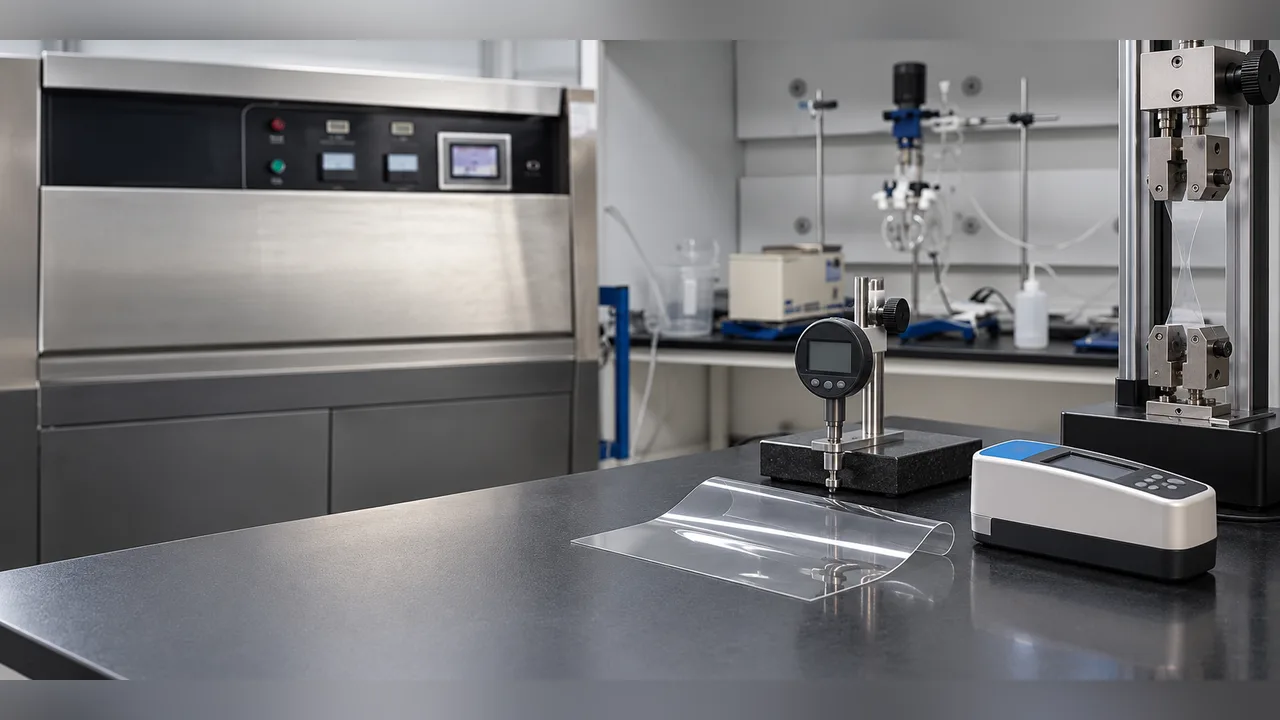
How to read a PPF data sheet in its test context
TPU paint protection film buyers often compare thickness, gloss, warranty years, or a single self-healing claim. These fields are easy to read but hard to interpret alone. A useful specification review asks what was measured, by which method, on which model or construction, and under which conditions.
This guide explains the main fields in a TPU PPF technical data sheet using the product structures and parameter groups documented in the CHISI knowledge base, together with public test-method references. A value for one model is not a universal industry limit. Keep the exact model, batch, method, and source revision with every claim.
Start with the film construction
A transparent PPF is typically a multilayer system. It may include a temporary PET protective layer, a functional topcoat, a TPU substrate, an acrylic pressure-sensitive adhesive, and a release liner. The layers perform different jobs:
| Layer | Main function | Questions to ask |
|---|---|---|
| Temporary protective layer | Protects the visible surface before and during installation | When is it removed, and does it affect inspection? |
| Functional topcoat | Influences surface appearance, chemical resistance, water behavior, and scratch response | What coating chemistry and test basis are specified? |
| TPU substrate | Provides flexibility, toughness, optical clarity, and impact absorption | Which TPU family and thickness are specified? |
| Acrylic pressure-sensitive adhesive (PSA) | Bonds to the painted surface and enables controlled removal | What are the tack, peel, shear, and residue results? |
| Release liner | Protects the adhesive before installation | Which liner and handling conditions are required? |
The data sheet should identify the construction clearly. TPU PPF describes a product family, not a complete performance profile.
Thickness: a higher number is not the whole decision
Thickness is usually stated in micrometers or mils. Depending on the supplier's measurement convention, the total may include the topcoat, TPU, adhesive, and other layers. Ask whether the figure refers to the complete construction or the TPU layer alone.
A thicker film can support impact protection and provide more material for installation, while also affecting conformability, edge appearance, cutting settings, and optical distortion. A thinner film may fit complex shapes more easily, with a different balance of impact and installation behavior.
Compare thickness alongside:
- tensile strength;
- elongation at break;
- tensile stress at 100% elongation, often called 100% modulus;
- tear or puncture behavior;
- gloss and haze;
- adhesive-layer thickness;
- the intended panel and installation method.
The CHISI knowledge base documents different thickness ranges for named transparent PPF families, with many examples around 160–300 μm. These are references for those families, not a general requirement for every PPF project.
Gloss, haze, and visual appearance
Gloss is measured at a specified angle, commonly 60 degrees. A high gloss reading can support a wet-look finish, but does not describe all aspects of clarity. Haze, orange peel, texture, pigment, and the underlying paint also affect the result.
For a clear film, request:
- the gloss measurement angle and method;
- haze or clarity data, where available;
- sample photographs in direct and diffuse light;
- details of the topcoat texture;
- a comparison on both dark and light painted panels.
For color PPF, also review color consistency, metamerism, surface texture, and changes in shade during stretching. A color film needs a different visual assessment from a clear film, even if both use TPU.
Peel force, tack, and cohesion
The adhesive is viscoelastic. It needs enough flow to make contact with paint, enough tack for initial positioning, adequate peel resistance in service, and sufficient internal cohesion to avoid splitting or residue during removal.
Key terms include:
- Tack: the ability to form a bond after light, brief contact.
- Peel adhesion: the force needed to remove film from a defined substrate at a specified angle and speed.
- Shear or holding power: resistance to sliding or creep under load.
- Cohesion: the internal strength of the adhesive mass.
- Dwell time: the time allowed for adhesive contact to develop before measurement.
Czech's 2024 open-access review explains that tack, peel adhesion, and shear strength are related but not interchangeable. It describes the balance between flow during bonding and resistance to deformation during removal. Acrylic PSA research also shows that both bulk viscoelastic behavior and the substrate interface affect adhesion.
One peel value is therefore not a complete forecast of installation behavior. Record the substrate, surface preparation, dwell time, peel angle and speed, temperature, humidity, and conditioning. ASTM D1000 addresses pressure-sensitive adhesive-coated tapes used for electrical and electronic applications; it is not a general PPF standard. Confirm the method appropriate to the specific PPF construction.
Elongation, specified-strain stress, and strength
These measurements describe deformation. Elongation at break is the extension reached before a specimen ruptures in a defined test. Tensile strength is the maximum tensile stress recorded under the stated test method. In elastomer data, 100% modulus means tensile stress at 100% elongation; it is not automatically Young's modulus. Use the exact definition in the stated method, and do not invent a unit missing from a product table.
Installers need to answer practical questions:
- How far can the film follow a curve before its appearance becomes unstable?
- Does it recover after heating or relaxation?
- Does a stretched area become thinner or change gloss?
- Can an edge be wrapped without excessive tension?
- How does temperature affect the response?
A data sheet cannot answer all these questions, but can help define the mechanical range. Connect the numbers to a sample trial on representative panels, recording installation temperature, stretching direction, and finishing method.
UV, QUV, xenon, and yellowing data
Weathering results are often misread. Fluorescent UV, xenon-arc exposure, heat aging, humidity cycles, and outdoor exposure apply different stresses. ASTM G154 concerns controlled fluorescent UV exposure that reproduces selected sunlight and moisture effects. Select and report the exposure cycle for the material being tested.
When a sheet reports UV rejection, UV exposure hours, QUV color change, or yellowing, ask:
- Which property was measured: transmission, color change, tensile retention, gloss retention, or a visual rating?
- Which instrument and cycle were used?
- Which specimen construction was tested?
- Was the result assessed before and after cleaning or chemical exposure?
- Is it a screening result, a specification limit, or a warranty basis?
Accelerated exposure can compare formulations under the same method. It cannot be converted into guaranteed outdoor years without a validated correlation model.
CHISI records UV, QUV, yellowing, gloss, and weathering values for named product families and 2026 OEM routes. Product PDFs and quotation sheets may differ, so use the exact source file and sheet supplied for the project. The owner-confirmed ASTM G154-16 Cycle 1 / 2000 h reference applies to the specified Type R data, not to every PPF or every test.
Impact and abrasion performance
Stone-chip resistance and abrasion differ from surface scratch recovery. SAE J400 describes a gravel-impact procedure for surface coatings on flat panels. SAE J2661 adds optical imaging to characterize damage after gravelometer testing.
Ask whether the test represents:
- a coating on a flat panel;
- a complete multilayer film on a painted panel;
- a free film;
- a film after weathering or chemical exposure;
- a defined impact medium and rating scale.
Substrate, panel shape, temperature, and impact method can change the result for the same product. Treat the number as evidence for its stated conditions, then assess a sample in the intended application.
Removal and paint safety
Removability depends on the process; it is not a permanent guarantee. Relevant factors include dwell time, temperature, paint age, clearcoat condition, film aging, adhesive formulation, peel angle, and installation or maintenance chemicals.
Request removal instructions and test them on representative painted panels. Record:
- the initial application conditions;
- aging or heat exposure;
- peel direction and speed;
- visible residue;
- changes to paint or clearcoat;
- the cleaning method after removal.
A general adhesive claim cannot replace a removal trial.
A template for comparing specifications
Use a separate table for each model or source revision. Do not combine the best values from different sheets.
| Field | Record precisely | Purpose |
|---|---|---|
| Model and revision | Product name, revision, and date | Avoids mixing versions |
| Construction | Layer order and nominal thickness | Defines what the values represent |
| TPU route | Material family and supplier statement | Connects chemistry with the test record |
| Topcoat | Function, thickness, and curing or processing details | Helps interpret gloss and scratch claims |
| Adhesive | Chemistry, tack, peel, shear, and dwell time | Connects installation with removal |
| Optical properties | Gloss angle, haze, and transmission | Supports appearance assessment |
| Mechanical properties | Strength, elongation, and specified-strain stress | Defines the deformation range |
| Weathering | Method, cycle, duration, and property change | Separates test evidence from service life |
| Packaging | Width, length, liner, and storage | Supports consistent field handling |
| Warranty | Model, conditions, and exclusions | Avoids overstating commercial commitments |
Frequently asked questions
Does thicker PPF always provide better protection?
No. Protection depends on the full construction, including TPU toughness, topcoat, adhesive, panel shape, and installation. Compare thickness with optical, mechanical, and handling data.
Does a high gloss reading prove clarity?
No. Gloss is one measurement. Haze, texture, surface defects, pigments, and the painted substrate also affect appearance.
Can peel values be compared across suppliers?
Only if substrate, angle, speed, dwell time, temperature, conditioning, and units are comparable. Otherwise, keep them as separate test records.
Do QUV hours equal outdoor years?
No. QUV is accelerated laboratory exposure. It supports controlled comparisons, but does not automatically predict field life.
What should be confirmed before ordering?
Confirm the model revision, construction, width, thickness convention, adhesive data, test methods, packaging, MOQ, warranty terms, and validity of quoted prices or delivery conditions.
A practical rule for buyers
Read a TPU PPF sheet as a chain of evidence: identify the layers, connect every performance value with its method, and assess the film on the intended panels and in the intended climate. A clear specification makes the remaining uncertainties visible and comparable.
References
- CMPE: PPF category
- ASTM G154: Fluorescent UV Exposure of Nonmetallic Materials
- ASTM D1000: Test Methods for Pressure-Sensitive Adhesive-Coated Tapes for Electrical and Electronic Applications
- SAE J400: Test for Chip Resistance of Surface Coatings
- Czech, 2024: Pressure-sensitive acrylic adhesives
- Wang et al., 2020: Bulk and interfacial contributions to PSA adhesion
Choose a film specification for sampling
Use the clear TPU PPF range to compare available grades and finishes. Confirm the full construction, roll specification, and applicable test conditions for the selected product. Request the relevant specifications and a sample from CHISI.