
Self-healing is a measured response, not a magic label
“Self-healing PPF” is a useful commercial phrase, but it can hide several different material mechanisms. Some surfaces recover a shallow mark when heat allows the polymer network to relax. Some coatings use reversible chemical or physical interactions. Some scratches only close visually while deeper damage remains in the film. The recovery speed can also change with scratch depth, temperature, pressure, humidity, and the number of repeated cycles.
This article explains how to evaluate self-healing claims in TPU paint protection film. It combines the product structure described in the CHISI knowledge base with peer-reviewed work on polyurethane coatings and public industry discussions about PPF topcoats. The research examples are not direct evidence for a commercial PPF model; they explain material mechanisms that help buyers ask better questions.
What a PPF “heals”
A PPF system can respond to a scratch at different levels:
- Surface appearance: the visible groove becomes less noticeable.
- Topcoat continuity: the surface layer partially closes or flows back together.
- Optical smoothness: gloss or haze returns toward its original condition.
- Barrier function: the film continues to resist water, chemicals, or contamination.
- Mechanical integrity: the film recovers strength or resistance to further damage.
These are different outcomes. A surface can look smooth while the underlying polymer is still weakened. A laboratory scratch can be shallow and uniform, while a stone impact can penetrate several layers. A product comparison should state which property was measured.
The role of the topcoat
The topcoat is the outer functional layer that the environment and cleaning process contact first. It may be designed to balance:
- scratch and mar resistance;
- flexibility during installation;
- chemical resistance;
- water behavior and stain release;
- optical clarity and gloss;
- UV and weathering stability;
- compatibility with the TPU substrate.
The PPF must remain flexible enough to follow a curved panel, yet the topcoat must resist marks and recover from appropriate surface damage. If the topcoat is too hard or too brittle, it may crack or lose adhesion during stretch. If it is too soft, it may show marks or collect contamination. The design is therefore a balance rather than a race toward maximum hardness.
Public industry discussions about PPF coatings describe formulation variables such as resin selection, additives, wetting, flow, intercoat adhesion, curing, and the choice between a coating layer and a multilayer film structure. Those topics are useful design questions, but they do not establish a performance ranking for every product on the market.
Four mechanisms behind “self-healing” behavior
Thermal relaxation and polymer mobility
Some thermoplastic surfaces recover when heat increases chain mobility. The material can relax local stresses and reduce the visual depth of a shallow scratch. The heat may come from warm water, sunlight, a controlled heat gun, or another approved method. The temperature window matters: too little heat may produce no visible change, while excessive heat can distort the film, affect the adhesive, or damage the paint system.
Shape-memory response
A shape-memory polyurethane can use stored elastic recovery to close a damaged region when it is heated above a transition range. Research on shape-memory polyurethane coatings has shown that heating can restore barrier properties after damage, but the result depends on the polymer architecture and the test design.
Reversible physical interactions
Some polyurethane coatings rely on hydrogen bonding, ionic interactions, cation–π interactions, or other reversible associations. A 2024 study by Xiang, Zhang and Lu on a transparent waterborne polyurethane reported high scratch-repair efficiency under defined laboratory conditions using cation–π interactions. That result demonstrates a material strategy; it is not a guarantee that a commercial automotive film uses the same chemistry or will produce the same recovery at ambient temperature.
Dynamic covalent chemistry
Other self-healing coatings use reversible covalent bonds, such as disulfide or Diels–Alder chemistry. These systems can restore part of their structure after damage, but they require a specific formulation and activation condition. A research coating that heals under a defined temperature or light source should not be described as an everyday PPF without a product-level test.
Why heat and scratch depth change the result
The same film can appear to heal quickly from a light surface mark and slowly from a deep cut. A shallow mark may be confined to the topcoat, while a deep cut can reach the TPU substrate or adhesive. The deeper damage has more material to move, more interfaces to reconnect, and a greater chance of permanent optical or mechanical change.
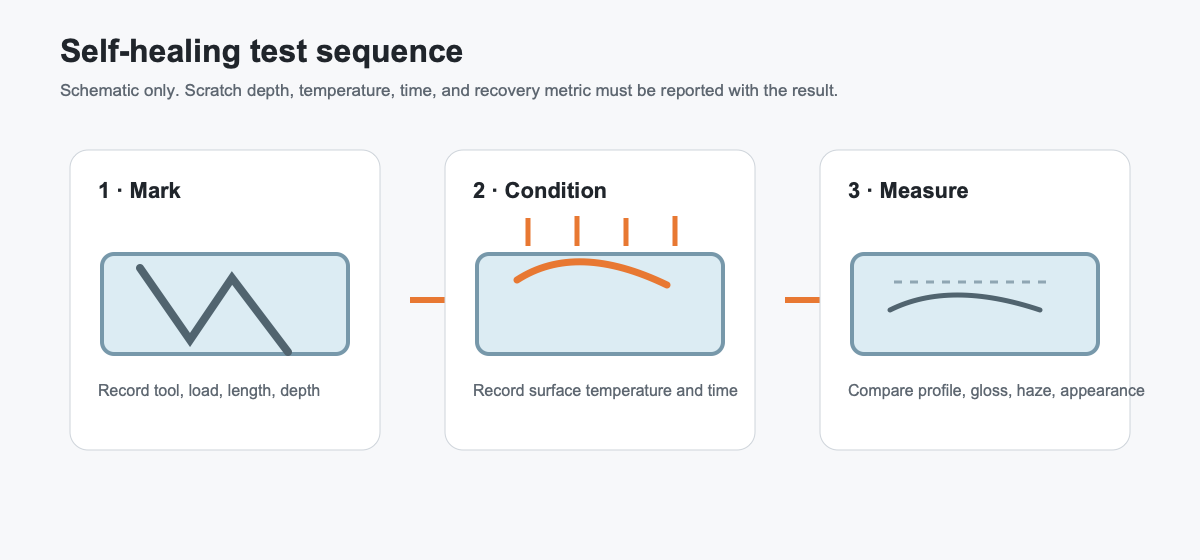
Temperature changes the balance between mobility and stability. At a higher temperature, polymer segments may move more easily, but the film may also soften, stretch, or lose dimensional control. A valid test therefore reports:
- initial temperature and conditioning;
- heat source and distance;
- surface temperature;
- scratch tool and load;
- scratch length and depth;
- recovery time;
- image or gloss measurement;
- number of repeated cycles.
Without these details, “heals in minutes” is a marketing phrase rather than a reproducible result.
How researchers measure recovery
Peer-reviewed studies use methods such as optical microscopy, profilometry, gloss measurement, surface-energy analysis, tensile testing, and barrier or corrosion testing. The method should match the property being claimed.
For a PPF buyer, a practical test matrix can include:
| Test | What it can show | What it cannot prove by itself |
|---|---|---|
| Controlled scratch and visual inspection | Change in visible mark | Full mechanical recovery |
| Gloss or haze before and after scratch | Optical recovery | Long-term weathering stability |
| Microscopy or profilometry | Scratch depth and closure | Vehicle-level installation behavior |
| Repeated scratch cycles | Durability of the response | Lifetime under every climate |
| Heat-cycle testing | Temperature sensitivity | Warranty life without field correlation |
| Chemical exposure after healing | Surface robustness | Compatibility with every cleaner |
The test should use the complete film construction rather than only a free topcoat when the claim concerns installed PPF. A free coating can behave differently from a topcoat bonded to TPU with an adhesive and liner history.
Self-healing, self-cleaning, and hydrophobicity are different
Self-healing refers to recovery after damage. Self-cleaning usually refers to reduced soil adhesion or the ability of rain and water to carry away contamination. Hydrophobicity describes water interaction at the surface, often measured through contact angle or roll-off behavior.
These properties can support one another, but they are not interchangeable. A water-repellent film may still show permanent scratches. A self-healing film may not be strongly hydrophobic. A surface can recover its water behavior after heating while its tensile properties remain unchanged or untested.
Research on polyurethane coatings has explored combinations of self-healing and self-cleaning, including systems that use dynamic bonds and low-surface-energy components. The result is a useful scientific direction, but buyers should ask which property was actually measured on the product they intend to purchase.
How PPF construction affects the response
The PPF stack creates interfaces that matter. The topcoat must remain attached to the TPU substrate. The TPU must retain clarity and flexibility. The adhesive must stay stable against the painted surface. The release liner and installation process can affect the surface before the final protective layer is removed.
The CHISI knowledge base describes common PPF structures using a PET protective layer, functional coating, TPU base, acrylic pressure-sensitive adhesive, and release film. It also distinguishes family-specific nano-silica, nano-ceramic materials, and nano-graphene coating routes. These names do not disclose a nano-ceramic formulation or turn coating-level properties into finished-film specifications. Model descriptions can have version differences; name the selected model and source in any technical article or quotation.
A buyer’s self-healing evaluation protocol
Before accepting a self-healing claim, request a sample and run a controlled comparison:
- condition all samples at the same temperature and humidity;
- mark the same area with the same tool and load;
- photograph the initial damage under the same light;
- apply the approved heat method and record the surface temperature;
- photograph at fixed intervals;
- repeat the test on a fresh area and after chemical exposure;
- inspect gloss, haze, visible damage, and edge behavior;
- record whether the mark closed, softened, or remained.
If the film will be sold into different climates, repeat the test at more than one temperature. If a color film is involved, record color change as well as scratch visibility.
What to write in a product page
A technically responsible product page can say:
- which layer provides the scratch-response function;
- which heat or care condition is approved;
- what type of mark the test covers;
- how the result was measured;
- which properties were not evaluated;
- how the warranty treats deep cuts, impact damage, chemicals, and improper care.
Avoid promising that every scratch disappears, that the film heals forever, or that a laboratory response equals a fixed outdoor lifetime. Those statements are difficult to defend and can confuse installers and customers.
Frequently asked questions
Does self-healing mean the TPU itself repairs every cut?
No. Many visible recovery claims relate primarily to a surface layer. The response depends on scratch depth and the material mechanism.
Can sunlight activate self-healing?
It may provide heat in some conditions, but the actual surface temperature and exposure time are variable. Use only the care method approved for the specific film.
Is a harder coating always more durable?
No. A coating also needs flexibility, adhesion, optical clarity, and resistance to cracking during installation. Hardness is one design variable.
How should two self-healing films be compared?
Use the same scratch tool, load, temperature, recovery time, imaging, and repeat-cycle protocol. Compare the complete construction and keep the test records.
What is the most useful supplier question?
Ask for the test method, scratch depth or load, activation condition, recovery metric, repeated-cycle result, and the exact model revision. A claim without those fields is difficult to evaluate.
Final rule
Self-healing PPF is best understood as a controlled material response. The topcoat, TPU substrate, interfaces, temperature, scratch depth, and test method all influence what the buyer sees. A good technical review makes those variables visible so the installer can select the right care method and the distributor can write a warranty that matches the evidence.
References
- CMPE: PPF coating development directions
- Khan et al., 2020, Self-healing and self-cleaning clear coating
- Mantala and Crespy, 2025, Waterborne Polyurethane Transparent Coatings for Self-Healing at Room Temperature
- Yu et al., 2018, Self-healing polyurethane nanocomposite films with recoverable surface hydrophobicity
- ASTM G154: Fluorescent UV Exposure of Nonmetallic Materials
Evaluate self-healing on the selected film
Review Type R175 Gloss TPU PPF as one available film for sample evaluation. Assess surface recovery under the temperature and test conditions relevant to your application. Discuss self-healing sample requirements with CHISI.