
A coating name is the beginning of a question
Nano silica, nano graphene, and nano ceramic are common phrases in automotive-film discussions. They can help a buyer describe a development direction, but they do not provide a complete performance prediction. The actual result depends on particle chemistry, size distribution, surface treatment, dispersion, loading, resin compatibility, coating thickness, curing, adhesion to the TPU substrate, and the test method.
This article provides a neutral framework for comparing these coating approaches in paint protection film. It uses the coating routes and product structures recorded in the CHISI knowledge base, industry discussions about PPF coating design, and peer-reviewed research on polyurethane nanocomposites. The comparison removes supplier and brand promotion. It also avoids treating a laboratory nanocomposite result as proof for a commercial automotive film.
What a PPF topcoat must do
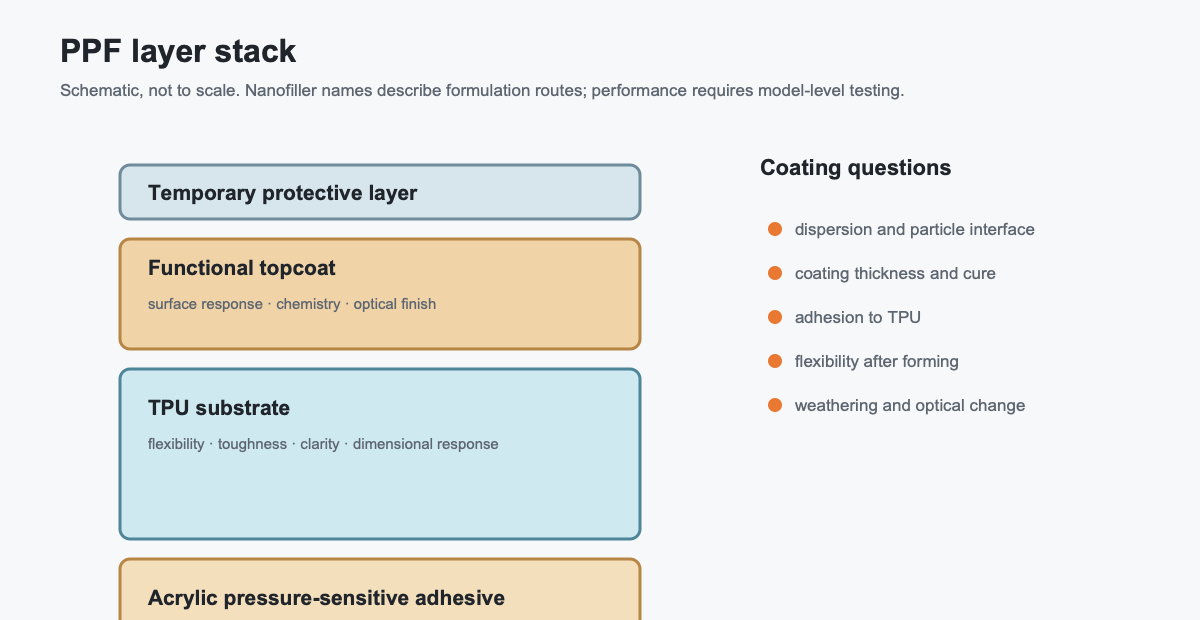
The topcoat is a thin, high-value layer. It must protect the surface without making the film too brittle, cloudy, difficult to process, or poorly bonded to the TPU substrate. Depending on the product, the topcoat may be expected to provide:
- resistance to fine scratches and marks;
- chemical and stain resistance;
- water behavior and easier cleaning;
- optical gloss or controlled matte texture;
- UV and weathering stability;
- self-healing response for shallow damage;
- flexibility during forming and installation;
- a stable interface with the TPU base.
No single filler guarantees all of these functions. The formulation must manage trade-offs between hardness, toughness, mobility, clarity, surface energy, and adhesion.
Nano silica: surface hardness, clarity, and dispersion questions
Silica nanoparticles can be used to modify hardness, abrasion response, surface energy, and barrier behavior. Their effect depends strongly on dispersion and interfacial chemistry. If particles agglomerate, they can create haze, roughness, weak points, or coating defects. If they are well dispersed and compatible with the resin, they may improve surface performance at relatively low loading.
For CHISI, GCX and Type B retain their established nano-silica designation. Descriptions of gloss, chemical resistance and scratch response apply to named models and test conditions; coating-technology parameters are not finished-film specifications. Request the applicable construction and test record instead of assuming every “silica” coating behaves alike.
Important questions include:
- What is the primary particle size and size distribution?
- Is the silica surface treated or functionalized?
- What resin or binder is used?
- How is dispersion verified?
- What loading level and coating thickness are used?
- How are haze, gloss, and adhesion measured after weathering?
Silica can improve one surface property while changing flexibility or optical behavior. The complete film must therefore be tested after forming, not only as a flat laboratory coating.
Nano graphene: barrier and reinforcement potential
Graphene and functionalized graphene can create high-aspect-ratio structures that influence barrier paths, mechanical response, electrical behavior, and weathering. A 2019 study on polyurethane/functionalized-graphene nanocomposite films reported improved weather-resistance and gas-barrier behavior under defined formulation and processing conditions. The paper is valuable because it shows the importance of functionalization, dispersion, and partial exfoliation. It does not mean that every graphene-labelled PPF will deliver the same result.
For a transparent automotive film, graphene raises additional questions. The filler must be dispersed without visible haze or color shift. The interface with the polyurethane must be stable under stretch and heat. The loading level must balance performance with optical requirements. A formulation that works for a dark or opaque coating may not be suitable for a clear PPF.
Buyers should ask for:
- visible-light transmission and haze;
- color difference before and after weathering;
- dispersion evidence or microscopy;
- tensile and elongation retention;
- chemical and UV exposure results;
- scratch and abrasion results;
- test results on the complete film stack.
The word “graphene” describes a family of structures and surface treatments. The processing route is part of the material specification.
Nano ceramic: a formulation category, not one material
In general coating literature, “ceramic coating” can describe different inorganic or hybrid chemistries targeting hardness, low surface energy or chemical resistance. This general term does not disclose any CHISI composition. CHISI nano-ceramic systems are described only as using nano-ceramic materials and must not be relabeled as nano-silica.
Because the term is broad, the buyer should request the chemistry family and the intended function. Does the coating target gloss, stain resistance, scratch response, hydrophobicity, hardness, UV stability, or a combination? What is the cure mechanism? Does the topcoat remain flexible enough for installation?
The CHISI knowledge base records nano-ceramic materials for some PPF families. Read that positioning with the named model, thickness, warranty and test data, without combining it with another family’s nano-silica or nano-graphene descriptions. Technology-page parameters concern the coating route; they do not automatically become finished-film performance or warranty.
Comparing the three approaches
| Coating route | Potential design focus | Main technical risk | Evidence to request |
|---|---|---|---|
| Nano silica | Surface hardness, optical finish, chemical and abrasion response | Agglomeration, haze, brittle behavior, adhesion loss | Dispersion, gloss/haze, abrasion, weathering, intercoat adhesion |
| Nano graphene | Barrier effect, reinforcement, weathering, tailored surface properties | Color or haze, dispersion, interface compatibility, process sensitivity | Transmission, microscopy, mechanical retention, UV/weathering, chemical resistance |
| Nano ceramic or hybrid | Hardness, stain release, low surface energy, chemical durability | Broad terminology, cure/flexibility balance, unclear chemistry | Material designation, cure conditions, contact angle, hardness, flexibility, weathering |
The table is a sourcing framework. It is not a product ranking.
Why dispersion and interfaces decide the result
Nanoparticles are small enough that their surface area and interface with the resin can dominate the formulation. Poor dispersion creates clusters. Clusters behave differently from individual particles and can scatter light, initiate defects, or weaken the film. Functionalization can improve compatibility, but it can also change viscosity, cure, and surface energy.
Peer-reviewed work on silica–graphene oxide nanohybrids in polyurethane acrylic coatings illustrates this principle. The study used functionalization and controlled hybrid preparation to improve dispersion and corrosion-related performance at a specified loading. It is a reminder that “additive present” is not the same as “additive effective”; it does not validate a commercial PPF.
The coating also needs a stable interface with the TPU substrate. Surface preparation, corona or plasma treatment, primer choice, coating solvent, wetting, drying, and UV or thermal cure can influence adhesion. A topcoat that looks good on a glass slide may behave differently on a flexible TPU web.
How manufacturing changes coating performance
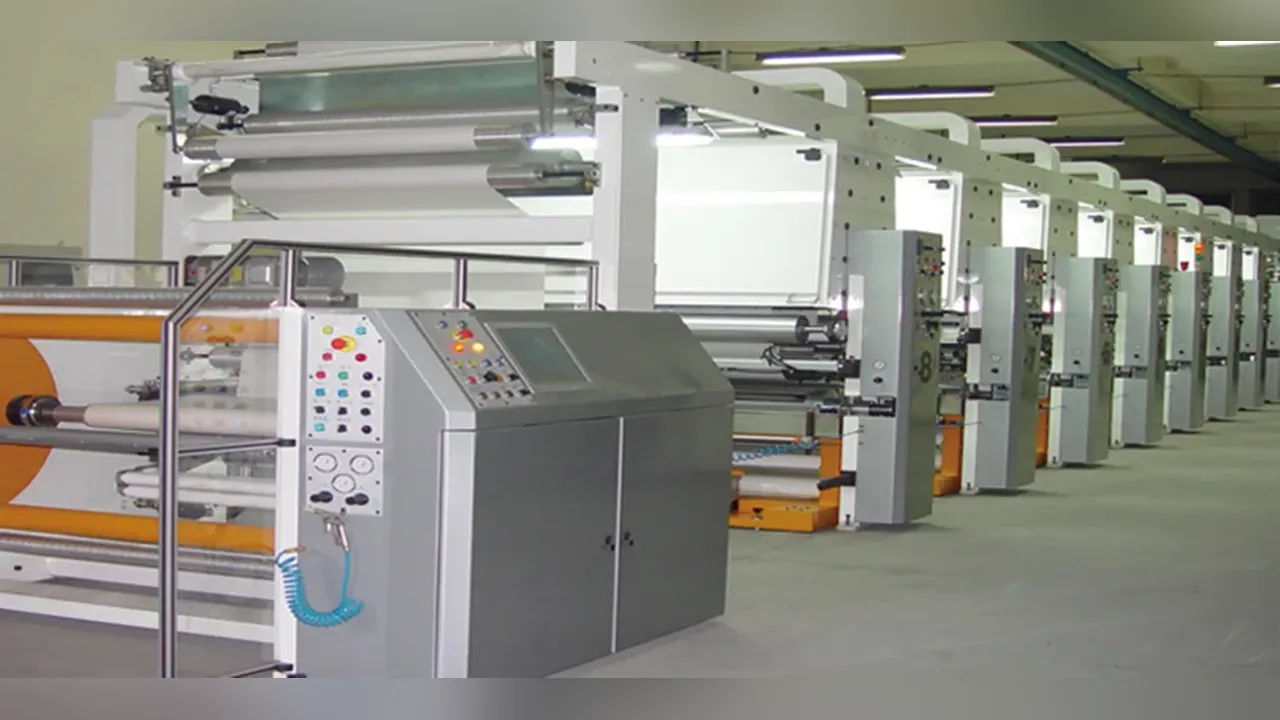
The coating chemistry and coating process cannot be separated. Industry process discussions identify substrate uniformity, adhesive or resin viscosity, roll condition, temperature, tension, alignment, and machine stability as variables that influence coating uniformity. A small coating-thickness variation can change gloss, haze, cure, scratch response, and local adhesion.
The process review should cover:
- TPU surface preparation;
- coating viscosity and temperature;
- wetting and flow;
- coating-head or roll settings;
- drying or curing energy;
- line speed and web tension;
- thickness measurement across the web;
- defect inspection and sampling;
- winding, storage, and conditioning.
Multi-layer co-extrusion can also change how a product delivers function. Instead of applying every property as a separate coating, a manufacturer may use different polymer layers or combine film and coating steps. The choice affects throughput, interface count, repairability, optical behavior, and scale-up risk. It should be evaluated as a process architecture rather than a slogan.
A practical test plan for coating selection
The buyer can compare candidate coatings with a staged plan.
Stage 1: optical screening
Measure gloss, haze, transmission, and color difference on the complete film. Inspect dark and light painted panels under direct, diffuse, and angled light.
Stage 2: surface response
Run scratch, mar, stain, water, and chemical tests using the same tools, loads, exposure time, and cleaning method. Record whether a mark is removed, reduced, or unchanged.
Stage 3: mechanical compatibility
Stretch and form the film over representative curves. Check for cracking, whitening, delamination, gloss change, and edge behavior.
Stage 4: weathering
Use a documented fluorescent UV, xenon, heat, or humidity cycle. ASTM G154 describes the controlled operation of fluorescent UV exposure devices and emphasizes that the exposure procedure and evaluation must be specified.
Stage 5: interface and adhesive checks
Measure coating adhesion to TPU, inspect the adhesive side, and repeat removal trials after aging. A topcoat that performs well but causes delamination or adhesive instability is not a successful PPF system.
How to avoid misleading coating comparisons
Do not compare a nano silica coating using abrasion data with a graphene coating using gas-barrier data and call one the winner. The tests answer different questions. Instead, define the buyer’s priority: optical clarity, scratch response, chemical resistance, low-temperature flexibility, UV stability, or cleaning behavior. Then use a common test matrix.
Do not use a coating name to infer self-healing. Self-healing depends on polymer mobility, reversible bonds, heat, scratch depth, and recovery measurement. A hard ceramic-like surface may improve abrasion or stain behavior without recovering a deep scratch.
Do not ignore the adhesive. A PPF is installed and removed through its adhesive layer. The topcoat, TPU, adhesive, and paint interface must be evaluated together.
Frequently asked questions
Is nano graphene always stronger than nano silica?
No. “Stronger” depends on the measured property and the formulation. Dispersion, functionalization, loading, and film construction can matter more than the additive name.
Does nano ceramic mean the film is brittle?
Not automatically. The effect depends on the hybrid chemistry, coating thickness, cure, and TPU interface. Flexibility and installation trials are essential.
Can a clear film use graphene without haze?
It may be possible with appropriate dispersion and loading, but the complete film must be tested for transmission, haze, and color shift.
What is the first question to ask a supplier?
Ask what the coating is designed to change, then request the test method, specimen construction, coating thickness, weathering condition, and post-exposure result.
Should coating chemistry be part of an OEM brief?
Yes. The brief should identify the target function, optical requirement, flexibility, process, cure, adhesive compatibility, test plan, and approved claim language.
Final selection rule
Nano silica, nano graphene, and nano ceramic are design routes rather than automatic quality grades. The most suitable coating is the one whose chemistry, dispersion, process, interface, and test evidence match the intended PPF use. A supplier conversation becomes more productive when the buyer asks for a complete film construction and a shared test matrix instead of a single additive label.
References
- CMPE PPF category
- CMPE: PPF coating development directions
- CMPE: coating-process variables
- Adak et al., 2019, Polyurethane/functionalized-graphene nanocomposite films with enhanced weather resistance and gas barrier properties
- Liu et al., 2020, SiO2-GO nanofillers enhance the corrosion resistance of waterborne polyurethane acrylic coatings
- ASTM G154: Fluorescent UV Exposure of Nonmetallic Materials
Connect coating concepts to finished films
Review the nano-silica coating technology and nano-ceramic coating technology pages for coating concepts. For a finished nano-graphene film, see Type R TPU PPF. Request a film sample from CHISI for evaluation under your intended conditions.