
Choose a paint protection film supplier by finished-film performance, production consistency and support as well as price. Compare the exact model and intended exposure for yellowing, cracking, adhesion and removal.
Assess four areas before comparing price: manufacturing capability, the actual material and coating system, test-data transparency, and supply-chain support. This framework helps distributors, dealers, installation businesses and brand owners decide what to ask, which evidence to request and how to assess it before comparing qualified offers.
Define the product position before approaching suppliers
Define the intended product before comparing manufacturers. Material route, warranty scope and target market guide the specification and commercial discussion.
Specify the film’s TPU grade, topcoat and adhesive, then compare finished-film tests and lot consistency. For material differences, use the substrate guide: the TPU, TPH, PET and PVC substrate guide.
A warranty defines coverage, conditions and remedies; its duration does not prove outdoor service life. Match it to the exact product and resale terms. Market and climate also affect the required thickness, finish, packaging and supporting evidence for yellowing resistance or self-healing.
Verify manufacturing capability
Request evidence of the actual production equipment, forming and coating processes, and cleanliness controls. A factory visit or documented audit can clarify which operations are in-house and which are outsourced; a catalog alone cannot.
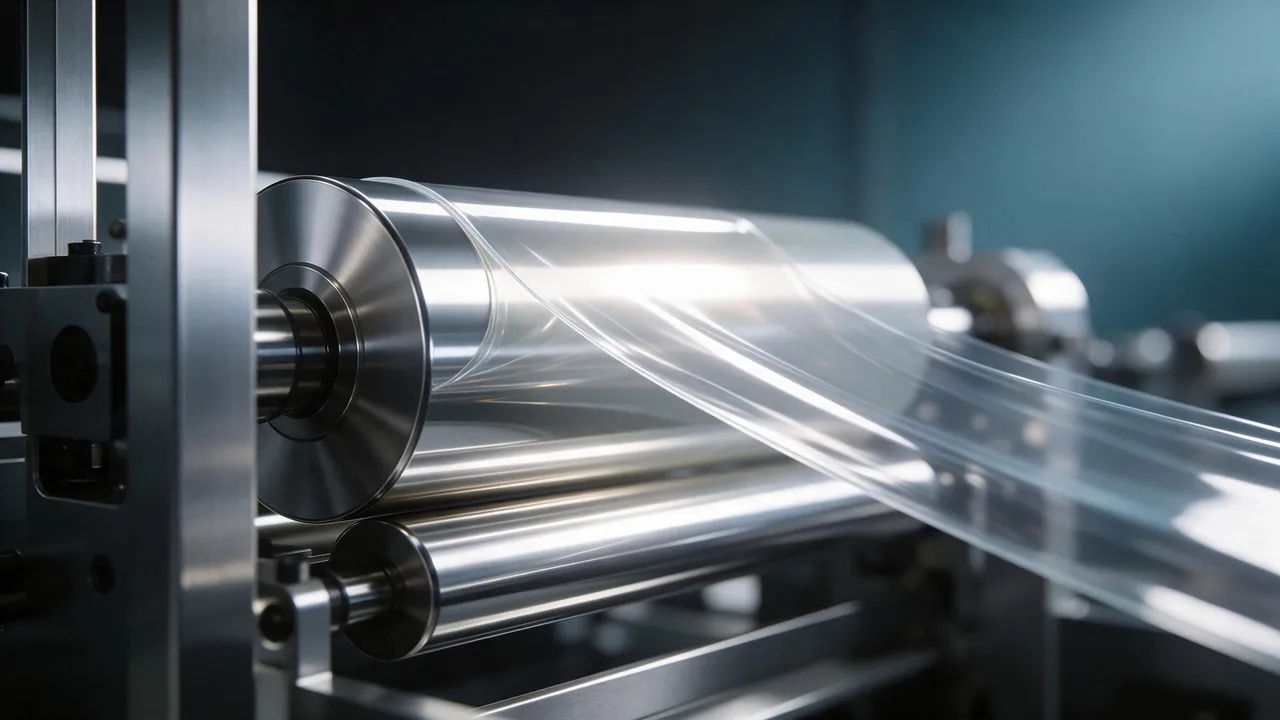
Forming and coating equipment
Film forming, coating and converting require controls suited to the product. A casting-line label does not prove thickness below 0.1 mm, optical quality or durability. Request nominal construction, thickness tolerances, inspection records and cleanliness controls. Evaluate samples and reports instead of treating an equipment name or cleanroom label as finished-film proof.
R&D and testing resources
Assess how durability claims are supported. Ask about relevant xenon, temperature-cycling, damp-heat and UV equipment, competent personnel, procedures and actual reports. In-house resources may support development, but owning equipment does not validate a formulation or guarantee market-specific customization; confirm the real capability and project scope.

Read the material and coating specification
Compare the TPU grade, topcoat, adhesive and thickness together. Use the model specification and applicable warranty terms when choosing a clear PPF range.
Topcoat, TPU and adhesive affect different aspects of the finished film. Confirm actual grades, polyol route, coating, thickness and adhesive. Polyol chemistry can affect hydrolysis response, but a polycaprolactone label does not establish service years or a humid-climate warranty; compare grade-specific evidence under stated conditions.
Request test data with its conditions
A gloss, peel or color-change figure needs its measurement method and conditions before comparison. For a field-by-field guide, see how to read TPU PPF specifications.
Key figures and their limits
- Color change (ΔE*ab): Agree the reference color, method, xenon or QUV procedure, exposure hours and acceptance rule for the actual product. ΔE*ab is color difference, not a yellowing-only index.
- Peel force / adhesion: Confirm the recorded unit, substrate, dwell, angle, rate, conditioning and removal instructions; do not infer removability from force alone.
- Gloss: Confirm the specimen, instrument and finish. A gloss result for a glossy model is not a matte or satin target, nor a measurement of the resin alone.
- Temperature references: Do not use it as a universal service limit, heat-gun setting or safe installation temperature. Confirm the exact model, test object, exposure duration, criterion and installation instructions; do not substitute another model’s temperature data.
Ask for the reference conditions
Request the actual report with sample thickness, substrate, exposure hours and measurement method. Mark unsupported claims as unverified and assess the gap; absence of a report alone is not a measured failure rate or proof of product quality.

Audit consistency and supporting documents
A good sample does not establish batch consistency. Ask how thickness, gloss and peel force are checked during production and how lots are traced. Examine applicable SGS reports and CQC, ISO or IATF 16949 documents for their holder, scope and validity. A report, a management-system certificate and product compliance are different; none automatically establishes approval for every export market.
Evaluate OEM/ODM scope and supply-chain support
For a private label, ask which surrounding services are actually available: branded packaging, warranty management, cutting systems, tools and compatible care chemicals. A logo-customized software version requires sales confirmation, not an automatic inclusion. For a planning example, see the private-label PPF program guide. Fewer suppliers may simplify coordination, but do not guarantee lower cost or faster launch. Confirm available customization of length, width, thickness, material route, diisocyanate/polyol options, substrate, hardness, coating, gloss and peel behavior, with the supplier’s technical team. Confidential formulas are not disclosed by a category name. Agree packaging and shipping separately.
Compare total landed cost
A low roll price can be offset by MOQ, payment terms or freight. Compare the complete landed-cost assumptions rather than the unit price alone.
| Cost item | What to confirm |
|---|---|
| Minimum order quantity | Confirm the applicable MOQ and quoted price tier. |
| Trade terms | For FOB, CIF, CFR, DDP or DAP, specify the agreed place and allocation of freight, insurance and other charges; do not assume all offers cover the same scope. |
| Payment | 100% payment in advance |
| Dispatch timing | In-stock CHISI products dispatch within 3–7 days; custom products dispatch within 15 days after specification approval. Transit depends on the route and shipping method. |
| Shipping unit | These are not universal dimensions or weights. Confirm the actual model, packing, net/gross weight basis and pallet plan for freight calculations. |
| Samples | Confirm sample availability before the first bulk order. |
Buyer evaluation checklist
Record each item as confirmed, partly confirmed or unknown, with its evidence and unresolved questions. Use the gaps to decide whether to investigate further or exclude an offer; the checklist is a procurement tool, not a certification score.
| No. | Evaluation item | Evidence to request |
|---|---|---|
| 1 | Forming and coating equipment | Equipment records, actual process scope and relevant cleanliness controls |
| 2 | Material route and topcoat | Resin grade/source, coating description and adhesive, within the disclosure scope |
| 3 | Test data with conditions | ΔE*ab, peel and gloss with method, specimen and relevant exposure or dwell time |
| 4 | Reports and applicable certificates | SGS reports and CQC, ISO or IATF 16949 documents: verify holder, scope and validity |
| 5 | OEM/ODM services | Confirmed customization list, packaging and warranty-management scope |
| 6 | Supply-chain support | Availability of cutting systems, tools and compatible chemicals; logo versions require sales confirmation |
| 7 | Total landed cost | MOQ, agreed trade terms, dispatch schedule and actual freight unit |
| 8 | Sample availability | Sample film before a bulk commitment |
Frequently asked questions
What should I verify first in a PPF manufacturer?
Verify the actual forming and coating capability, equipment, process ownership and relevant cleanliness controls. Site evidence and traceable records help distinguish a manufacturer’s work from outsourced operations; no single equipment or cleanroom label establishes finished-film quality.
How can I compare two PPF quotations fairly?
Align the resin grade, topcoat, adhesive, construction and thickness first. Then compare landed-cost assumptions, including MOQ, trade terms, dispatch schedule and freight.
Which test data should a supplier provide?
Color stability: Agree the color-difference system, exposure procedure, duration and acceptance tolerance for the selected product. A threshold without those conditions is not a universal PPF requirement.
Why does resin origin matter?
Resin grade, coating, adhesive and processing together influence durability, gloss and recovery behavior. Covestro, BASF Elastollan and Lubrizol are material references, not a sufficient ranking of finished-film performance. Confirm the selected grade and product evidence.
Can one manufacturer support a private-label program?
Potentially, depending on its confirmed scope: film, packaging, warranty management, cutting systems, tools and compatible care products. Confirm each service and commercial condition; software logo customization needs sales confirmation. Fewer contacts may simplify coordination but do not guarantee cost or launch-time savings.
A practical selection rule
Prefer a supplier that can document the factory processes, actual materials, applicable reports and supporting services you need. Qualify the technical and commercial fit before negotiating price. Price still matters among qualified offers; this framework does not guarantee which supplier will win or how a project will perform.
Suggested next step
For a specific sourcing project, review Type B PPF and Type R PPF for the exact models and finishes, then request samples and an OEM discussion through the OEM/ODM catalog. Ask the supplier to explain its actual processes, applicable material route and reports for your target market before a bulk commitment. Start by contacting the team.
References
- CMPE PPF category: industry discussion, not independent verification of a CHISI product.
- CHISI internal product and factory documents: equipment, cleanliness controls, material routes and test records; check the applicable version and scope for the selected model.
Material reference: Covestro: chemical properties of TPU. This supports general material context, not a CHISI product test result.