
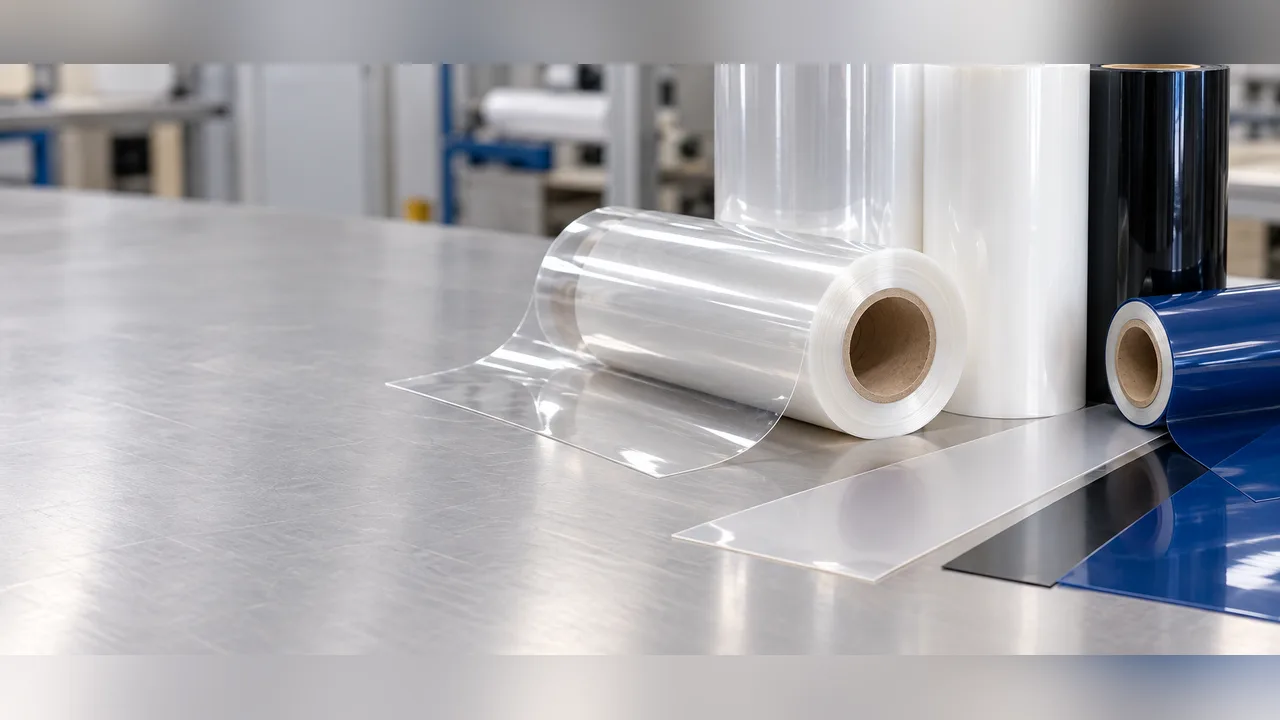
The substrate sets the starting point, not the finished product
When buyers compare automotive films, they often begin with the visible finish: clear, matte, metallic, color-shifting, or dark. Materials science starts one layer earlier. The substrate controls the film’s basic flexibility, dimensional behavior, optical response, chemical sensitivity, and processing window. The topcoat, adhesive, pigment, liner, and manufacturing process then shape the final product.
TPU, TPH, PET, and PVC can all appear in automotive film discussions, but they serve different design goals. The right choice depends on the surface, climate, installation geometry, appearance, required protection, and cost structure. This guide provides a neutral comparison for buyers and product teams. It does not treat one polymer as universally superior.
What the four materials mean in an automotive-film context
TPU: a flexible thermoplastic polyurethane base
TPU is a segmented polymer that combines soft and hard domains. Its balance of elasticity, toughness, clarity, and processing flexibility makes it a common substrate for paint protection film and other protective applications. The exact performance depends on the diisocyanate, polyol, hard-segment content, molecular weight, additives, processing history, and final construction.
The CHISI knowledge base describes TPU transparent PPF, color PPF, sunroof film, and headlight film families. It also records different material routes across product families, including aliphatic TPU and different coating systems. Those details should stay tied to the named model.
TPH: an alternative thermoplastic film route
TPH is used in some automotive film products as a material route that can support color, tint, or light-protection applications. In a finished headlight or decorative film, the product’s behavior depends on the exact polymer blend, thickness, topcoat, pigment, adhesive, and processing route. “TPH” alone is not enough to predict clarity, self-repair, or outdoor durability.
The CHISI knowledge base lists TPU and TPH versions for headlight film, with different example values for tensile strength, elongation, and self-healing. Those numbers are model-specific. Buyers should request the exact construction and test conditions instead of transferring a TPU result to a TPH product.
PET: a dimensionally stable polyester film
PET is valued for dimensional stability, optical clarity, smooth surface, and good processing behavior in many film applications. It is widely used as a carrier, liner, or visible film substrate depending on the product. For color and decorative automotive films, PET can support a crisp appearance and controlled thickness, but flexibility and impact behavior differ from TPU.
PET color film is therefore evaluated differently from a soft, stretchable PPF. Color consistency, coating adhesion, dimensional change, bending performance, and installation temperature can matter more than deep stone-chip protection.
PVC: a versatile vinyl film route
PVC is common in color-change and graphic applications because it can be formulated for calendering, casting, pigmentation, and surface effects. Plasticizers, stabilizers, pigments, polymer molecular weight, and processing conditions influence flexibility, shrinkage, and outdoor behavior.
PVC color film is not a direct substitute for a transparent TPU PPF. It may be the right material when the primary goal is color change, branding, or decorative coverage. The buyer should define whether the film is expected to protect against impact, change appearance, or do both.
Side-by-side comparison
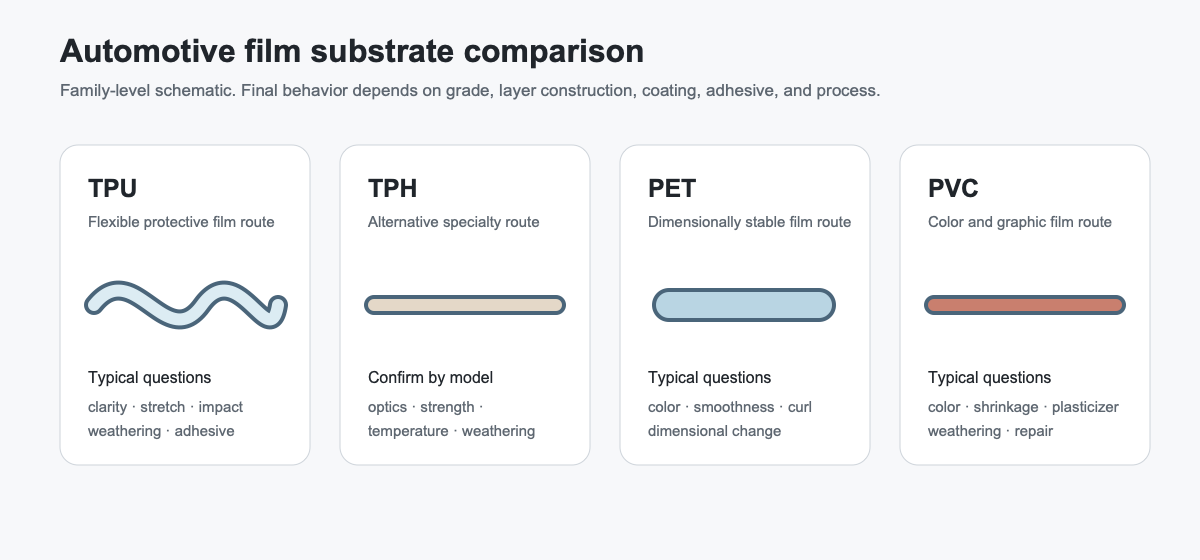
| Substrate | Typical design strength | Main trade-off to investigate | Common automotive-film roles |
|---|---|---|---|
| TPU | Elasticity, toughness, clarity, conformability | Cost, formulation sensitivity, coating and adhesive balance | Clear PPF, color PPF, sunroof and light protection |
| TPH | Flexible film route for selected protective or tint applications | Exact blend and long-term weathering must be verified | Headlight and specialty films |
| PET | Dimensional stability, smoothness, optical consistency | Lower stretch and different impact behavior | Color, decorative, carrier, and specialty films |
| PVC | Formulation flexibility, color range, processability | Plasticizer migration, shrinkage, weathering, and repair behavior | Color-change and graphic films |
The table is a starting point. A finished film is a system, so a well-designed PET or PVC construction may outperform a poorly designed TPU construction for its intended use.
Why the TPU formulation matters
TPU is not one fixed material. The soft segment can be based on polyester, polyether, polycaprolactone, or other chemistry. The hard segment can use different isocyanate families and chain extenders. Each choice changes the balance of hydrolysis resistance, flexibility, low-temperature behavior, strength, clarity, and weathering.
Industry discussions about PPF often highlight aliphatic systems for color stability and compare different polyol routes for durability. These conversations are useful as a research map, but the buyer should request the supplier’s own test data. A material label does not replace a complete construction record.
Polycaprolactone is one example of why structure matters. Its ring-opening polymerization can produce a polyester polyol with controlled molecular characteristics, and its flexible chain structure can support low-temperature flexibility. However, the performance of a finished PPF still depends on the complete TPU formulation, topcoat, adhesive, process, and exposure condition.
The role of topcoat and adhesive
Substrate selection does not decide surface performance by itself. The topcoat may add scratch response, chemical resistance, water behavior, optical smoothness, or UV protection. The adhesive must balance initial repositioning, final adhesion, shear stability, and clean removal. The release liner controls storage and installation handling.
For example, a flexible TPU film with an overly rigid topcoat may resist a shallow mark but crack during installation. A dimensionally stable PET film with an adhesive that lacks sufficient wet-out may look precise but fail to conform to a curved panel. A PVC color film with an unsuitable plasticizer or topcoat may shrink or change appearance under heat.
The correct question is therefore not “Which substrate is best?” It is “Which complete layer system matches the surface, climate, process, and service promise?”
Matching material to use case
Clear paint protection
For clear PPF, buyers usually prioritize optical clarity, impact resistance, conformability, yellowing resistance, scratch response, and adhesive removal. TPU is often selected because it can combine flexibility and toughness, but the product should be reviewed by model and test method.
Color change and decorative coverage
For color film, appearance consistency, color range, texture, dimensional stability, installation behavior, and repairability may lead the decision. PET or PVC can be suitable for specific visual goals, while color TPU PPF is considered when appearance change and protective behavior are both required.
Headlight protection
Headlight film requires optical transmission, heat exposure tolerance, curvature handling, chemical resistance, and a clean edge. TPU and TPH products should be compared on their exact thickness, optical data, tensile properties, and approved temperature range.
Sunroof and glass applications
Sunroof film adds requirements related to visible light transmission, infrared or solar rejection, UV performance, heat, and safety. A film designed for painted panels should not be transferred to glass without validating the optical and thermal requirements.
A buyer’s test plan
Use the same test logic for every substrate, then add material-specific checks.
- Optical: transmission, haze, gloss, color difference, and appearance under multiple lights.
- Mechanical: tensile strength, elongation, modulus, tear or impact response.
- Environmental: UV, heat, humidity, chemical exposure, and low-temperature flexibility.
- Dimensional: shrinkage, curl, and change after heat or weathering.
- Adhesive: tack, peel, shear, dwell, residue, and removal after aging.
- Installation: stretch, recovery, edge behavior, cutting, and repair.
Each result should identify the specimen construction and conditioning. ASTM G154 can be used as a reference for fluorescent UV exposure practice. SAE J400 can support a defined chip-resistance evaluation on exterior coating systems. Neither method replaces a complete vehicle-level validation program.
Common mistakes in material comparison
Comparing polymer names without construction details
TPU, TPH, PET, and PVC are broad material families. The grade, additives, thickness, topcoat, adhesive, and process may matter more than the label.
Treating price as a performance indicator
Material cost, coating complexity, width, yield, processing, packaging, and service all affect price. A lower price does not identify a weakness, and a higher price does not prove a better fit.
Mixing data from different models
A data table can look precise while combining a TPU value from one model, an adhesive value from another, and a warranty from a third. Keep each model and source version separate.
Using one climate assumption for the whole market
Heat, humidity, UV intensity, road debris, cleaning chemistry, and installation practice vary by region. The test plan should reflect the market where the film will be sold.
Frequently asked questions
Is TPU always the best choice for PPF?
TPU is a strong candidate for many clear protective applications, but the right choice depends on the complete film system and the target use. A validated sample and test record are more useful than a universal claim.
Can PET replace TPU in transparent PPF?
It can serve different film functions, but PET has different stretch, impact, and conformability behavior. It should be evaluated for the specific panel and protection requirement.
Why can two PVC color films behave differently?
PVC films can use different polymer grades, plasticizers, pigments, stabilizers, thicknesses, and topcoats. Those variables affect shrinkage, flexibility, appearance, and weathering.
Is TPH a single standardized polymer?
No. Commercial terminology can cover different formulations or blends. Ask for the material definition, construction, and test data for the exact product.
What should an importer request first?
Request the layer structure, model revision, width, thickness convention, optical data, mechanical data, weathering method, adhesive method, installation guide, MOQ, packaging, and warranty conditions.
Final selection rule
Choose the substrate by the job it must perform, then verify the topcoat, adhesive, process, and evidence as one system. TPU, TPH, PET, and PVC each have legitimate roles in automotive films. The strongest product decision is the one that connects material science to installation reality and a clearly documented service promise.
References
- CMPE PPF category
- CMPE: TPU substrate selection discussion
- CMPE: Polycaprolactone structure and properties
- CMPE: TPU extrusion and casting overview
- ASTM G154: Fluorescent UV Exposure of Nonmetallic Materials
- SAE J400: Test for Chip Resistance of Surface Coatings
Match the film to its application
For automotive paint protection, review the clear TPU PPF range. For glass applications, browse the window film range. Send CHISI your substrate and application requirements when requesting samples.