
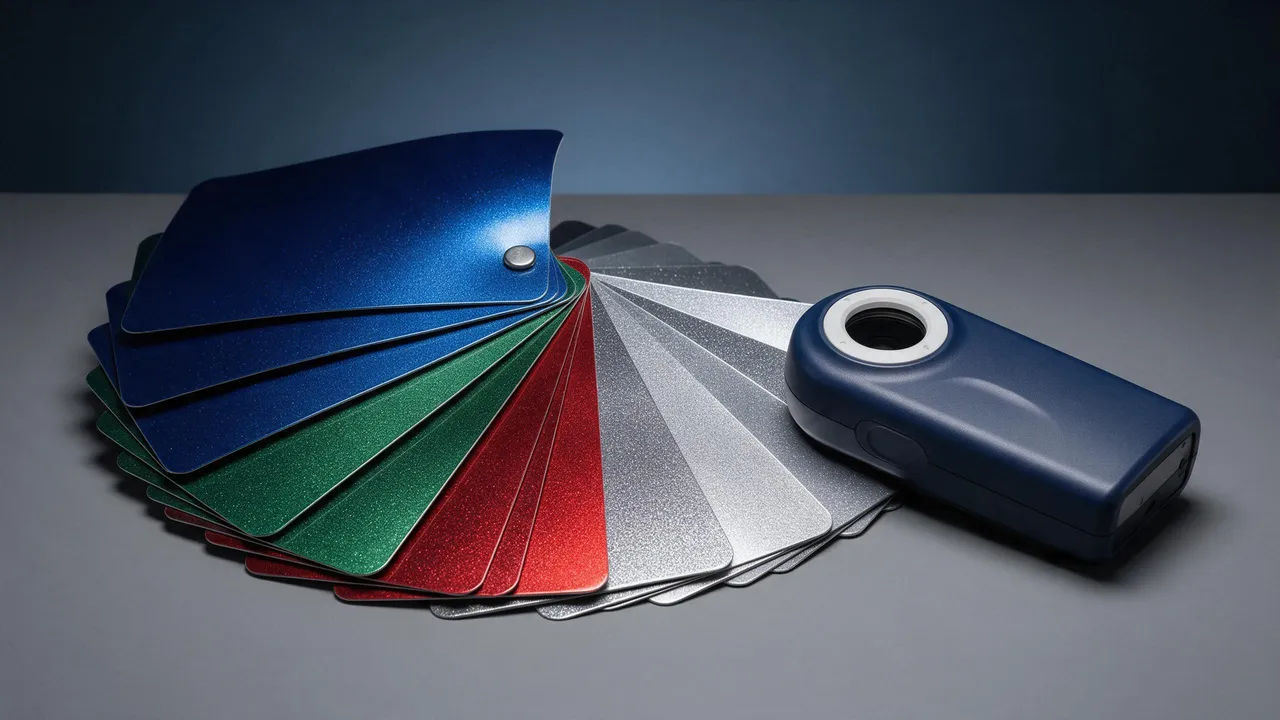
Short answer: Matching color PPF requires both visual assessment and documented measurement. Pigment lot, film thickness, effect-pigment orientation and gloss can change the appearance between a fan sample and a vehicle. Record the color-difference formula, illuminant, observer and measurement geometry with every specification.
Color film adds matching requirements to the evaluation of gloss, clarity and yellowing. Agree whether the reference is a paint code, a physical sample or an adjacent panel. Visible mismatch can cause disputes, but visibility and viewing distance depend on the finish and assessment conditions.
This guide covers causes of color variation, measurement conditions, limits of ΔE interpretation and purchase specifications that suppliers and installers can verify.
On this page
Why paint and color film can differ
Paint and film may use pigments, but their layer constructions and processing differ. These differences can affect color; they do not mean every film necessarily drifts.
A finished laminate is not adjusted like wet paint. In a paint system, coating formulation and application can influence depth and angular appearance. In a finished color film, the supplied color layer, topcoat and adhesive construction are already established; assess the actual laminate before purchase.
Thickness can affect appearance. Light transmission and return through a pigmented layer can affect perceived depth.
Effect-pigment orientation depends on processing. Metallic and pearlescent appearances depend partly on flake orientation. Paint application and film-forming or coating processes can influence that orientation. A film may match a painted panel at one angle and differ at another; verify the relevant process and finished product rather than assuming one manufacturing route.
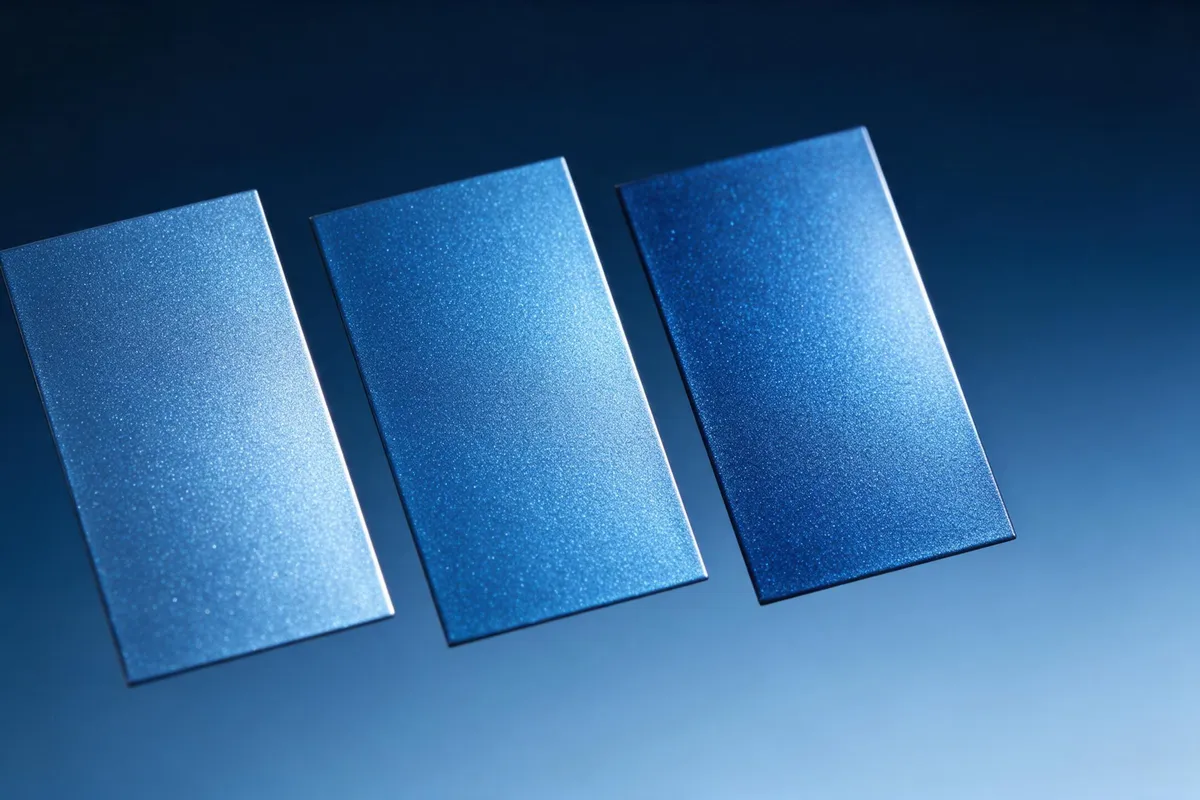
Appearance changes with viewing angle. Effect finishes can vary in lightness, hue and sparkle with angle and lighting. A single-angle reading may miss these differences. Combine agreed multi-angle measurements with controlled visual assessment.
Measuring color difference
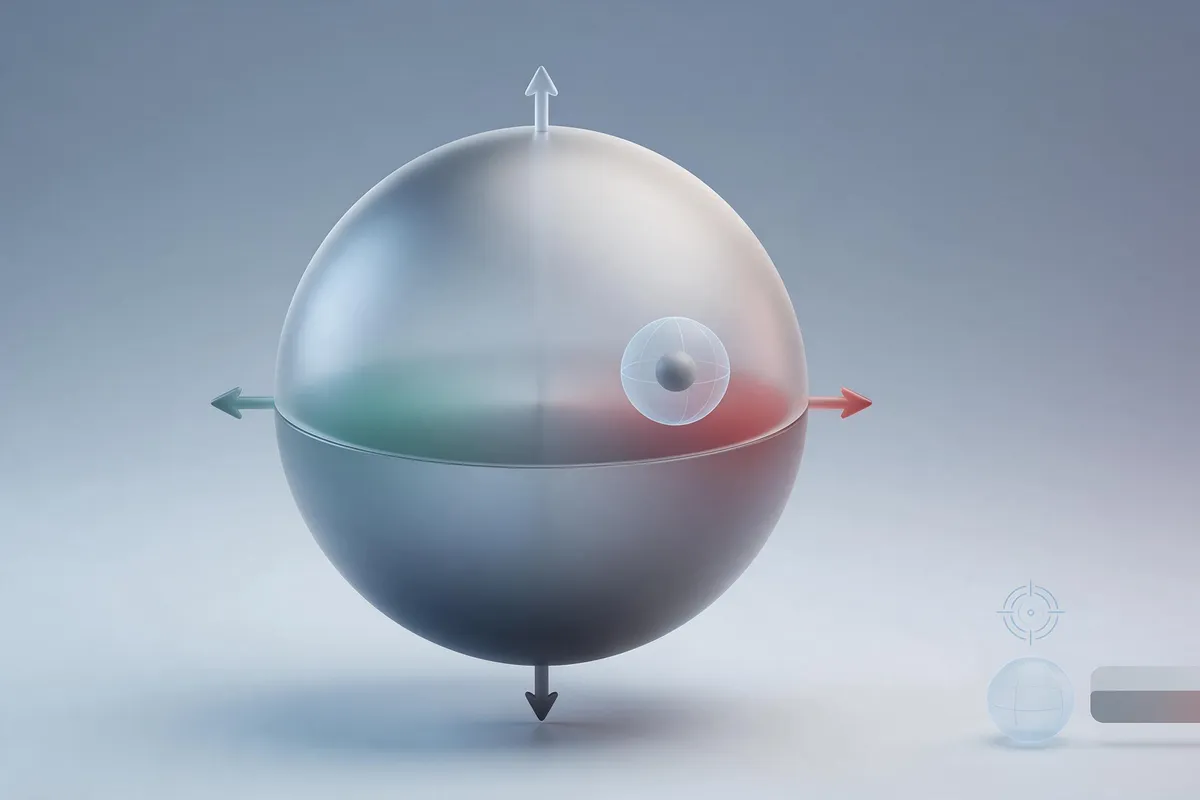
CIELAB describes color using L* for lightness, a* on the green–red axis and b* on the blue–yellow axis. CIE76 expresses color difference as the Euclidean distance between two points in this space.
CIE76 uses the following straight-line distance:
ΔE*ab = √(ΔL*² + Δa*² + Δb*²)
CIELAB is not perfectly perceptually uniform. CIEDE2000 (ΔE00) adds corrections to improve the relationship with perceived differences in its intended conditions.
State these three groups of conditions with the result:
- Illuminant and observer. D65 with a 10° observer and illuminant A are source examples for daylight and warmer-light checks. Agree the actual settings for the intended use; they are not stated here as a mandatory automotive default.
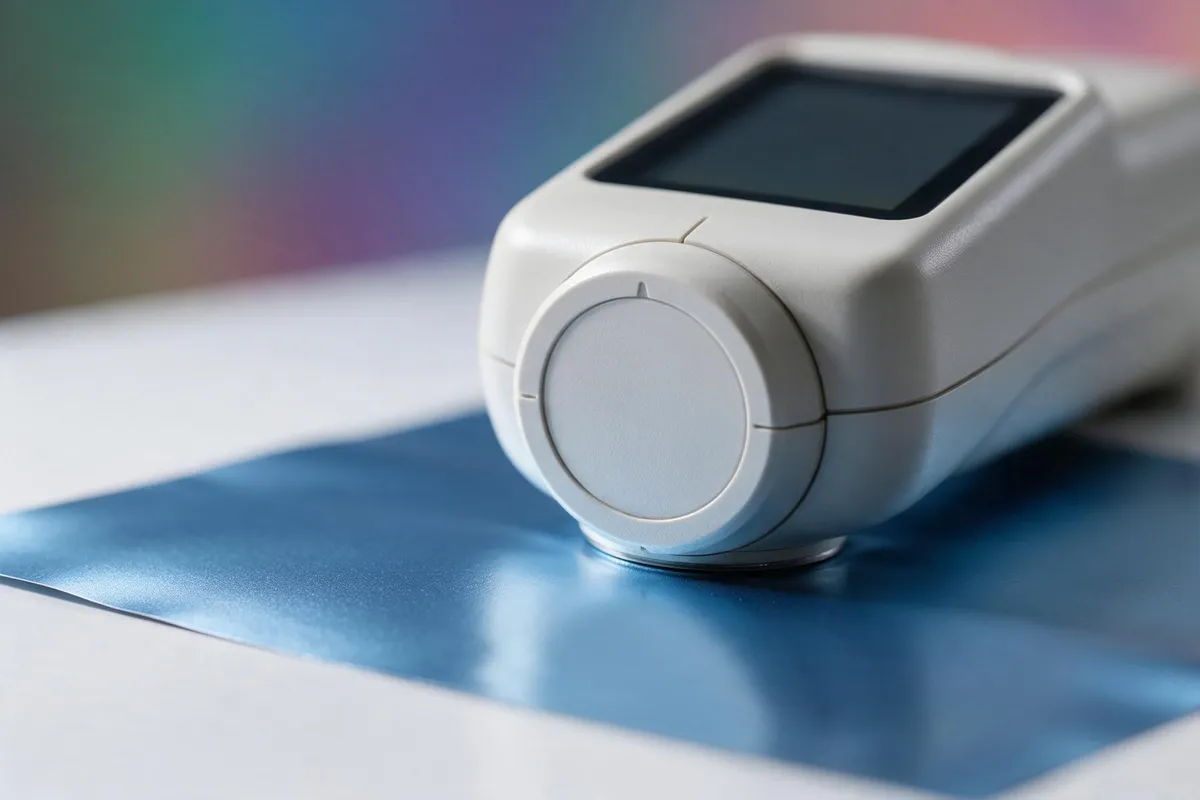
- Measurement geometry. Record 45/0, integrating-sphere d/8 or the actual geometry, including specular inclusion or exclusion. Results from different configurations are not automatically comparable.
- Measurement angles. Choose the angle set for the finish and reference method. Solid-color protocols may use one geometry, while metallic and other effect finishes may require several angles to assess angular changes.
Interpreting ΔE on a vehicle
The ranges below are source discussion examples, not validated visibility thresholds, a standard or CHISI acceptance limits. Lighting, color, finish, panel geometry and adjacency affect perception. Agree visual and instrumental acceptance criteria together.
| ΔE00 | Possible appearance, depending on conditions | Source planning example, not automatic acceptance |
|---|---|---|
| 0–1.0 | A small measured difference; visual detection is not ruled out | Candidate batch target to validate for the program |
| 1.0–2.0 | May be noticeable in side-by-side comparison | Assess separate panels against the agreed criteria |
| 2.0–3.0 | May be more apparent, depending on the color and conditions | Check adjacent panels and full wraps; neither is automatically acceptable |
| 3.0–5.0 | Potentially noticeable shade difference | Review a partial installation against the agreed limits |
| Above 5.0 | A larger numerical difference; assess its visual significance | Accept or reject using the agreed specification |
A full wrap and a partial repair create different comparisons, but neither has a universal tolerance. Pay particular attention to surfaces that share an edge, such as a door and front fender, and inspect the whole vehicle under agreed conditions.
Six sources of mismatch
| Source | Possible mechanism | Control to specify |
|---|---|---|
| Pigment batch | Pigment lot and dispersion can vary | Approved master and agreed incoming inspection |
| Film thickness | May affect optical depth and hiding power | Defined thickness tolerance and verified measurement |
| Flake size and orientation | Can change angular appearance and sparkle | An appropriate multi-angle assessment |
| Topcoat gloss | Can influence appearance and instrument readings | Compare approved film swatches under the same lighting and viewing geometry. Record the batch, finish and color-measurement method. |
| Substrate color | The substrate may affect a translucent film's appearance | Use defined black and white backing charts |
| Approval lighting | Metamerism: a match under one illuminant may differ under another | Agree more than one illuminant; D65 and A are source examples |
Two samples can look alike under one light and differ under another because their spectral reflectance differs. Check the illuminants relevant to the installation environment. Agreement under shop LEDs alone does not establish agreement in daylight or every other light.
A batch-control framework
The following four elements form a proposed procurement framework. Confirm what the supplier actually implements rather than treating the list as an existing CHISI process.
- A retained master standard. Keep an approved physical sample under documented storage conditions and define its review or replacement interval. Compare batches with that master, not only with the preceding batch, to avoid losing track of cumulative change.
- Agreed numerical limits. If relevant to the program, specify ΔE00 and separate ΔL*, Δa* and Δb* limits. Use them with visual assessment; one total color-difference value does not describe every direction or aspect of a color change.
- Batch identification on the roll. Agree batch identification on the core label and packaging, and confirm whether the required quantity can be supplied from one batch for a vehicle.
- Retained samples for each batch. Define sample retention and recordkeeping in the agreement. Samples, inspection records and installation evidence may all contribute to a later investigation.
For a private-label program, discuss these controls in the supply agreement. For commercial planning, see launching a color PPF product line.
Writing a specification
The following eight items are a source-derived specification framework, not a standard or an existing CHISI guarantee. Agree the methods, limits and evidence appropriate to the product and order.
Compare approved film swatches under the same lighting and viewing geometry. Record the batch, finish and color-measurement method.
A documented specification gives both parties a common basis for assessment. Investigate complaints using the agreed reference, measurement conditions and visual criteria; a number alone does not resolve every installation or appearance issue.
Checks at the installation shop
Mixing batches or overlooking panel adjacency can introduce a mismatch even when a batch meets its agreed limits. Inspect the actual roll and vehicle before installation.
- Plan one batch per vehicle where possible. Check the batch label and available quantity before cutting. If different batches must be used, assess and agree the appearance before installation; no failure-frequency claim is made here.
- Plan the panel sequence. Inspect the roll for variation before cutting and plan adjacent panels consistently. Do not conceal an out-of-tolerance area by placing it in a less visible position; resolve it against the agreed criteria.
- Use agreed viewing conditions. Inspect relevant viewing angles and lighting, including daylight where appropriate. Daylight changes with conditions, so it does not replace a documented, controlled approval process.
- Photograph the approved installation. Keep photographs with the reference and installation records. Images can document panel relationships and visible issues, but camera settings, lighting and displays mean they are not a substitute for calibrated color measurement.
- Do not assume different films will match. The same paint-code description does not establish a match between manufacturers or product constructions. Verify the actual samples, including effect-pigment appearance, before combining films.
For a partial installation adjoining original paint, agree expectations at quotation.
Frequently asked questions
What is a suitable ΔE target for color PPF?
Choose limits for the reference, finish, measurement method and intended installation. There is no universal rule that a value below 1.0 is invisible or above 3.0 is always obvious.
Why can color film look different in daylight?
Metamerism can make two samples match under one illuminant and differ under another. Check more than one relevant illuminant; D65 and A are source examples. Changes in viewing angle, gloss and surroundings can also affect appearance.
Can color PPF match every paint code?
Do not assume an exact match from a paint-code label. Laminate construction and effect pigments can limit the match, especially for complex finishes. Request measured and visual comparisons with the actual reference panel; this is not evidence of vehicle-brand authorization or an invisible repair.
Are ΔE00 and ΔE*ab the same?
No. CIE76 (ΔE*ab) is the Euclidean distance in CIELAB. CIEDE2000 (ΔE00) applies additional corrections for perceptual non-uniformity. Specify the formula and conditions; the values are not interchangeable and have no universal conversion factor.
Why can two rolls of one color differ?
Pigment lot, dispersion, thickness, effect-pigment orientation and gloss can vary between runs. Verify batch records and samples. Batch control can reduce variation but does not establish zero variation or guarantee that different batches match.
Does gloss affect color measurement?
It can. Specular reflection and measurement geometry influence the result; glossier does not universally mean darker. Record gloss and color methods separately and choose a gloss angle appropriate to the finish.
How should a distributor approve a new color?
Use an agreed physical master, relevant illuminants, documented instrument geometry and angles, and visual assessment. Retain the approved sample and records under the supply agreement. Neither eyesight alone nor an isolated ΔE value fully defines approval.
Specify the color and the conditions
A reference sample, formula, tolerance, illuminant, geometry and angle set make a color requirement more assessable. Use these alongside agreed visual criteria; a sample fan or an unqualified promise alone is not a complete purchase specification.
Explore our manufacturing and R&D capabilities for information on development and production. The OEM and ODM catalog introduces available color-family options; confirm the current product, sample and specification for your order. To discuss your sourcing requirements, contact our team with your reference panel, proposed tolerance and expected quantity per color.