
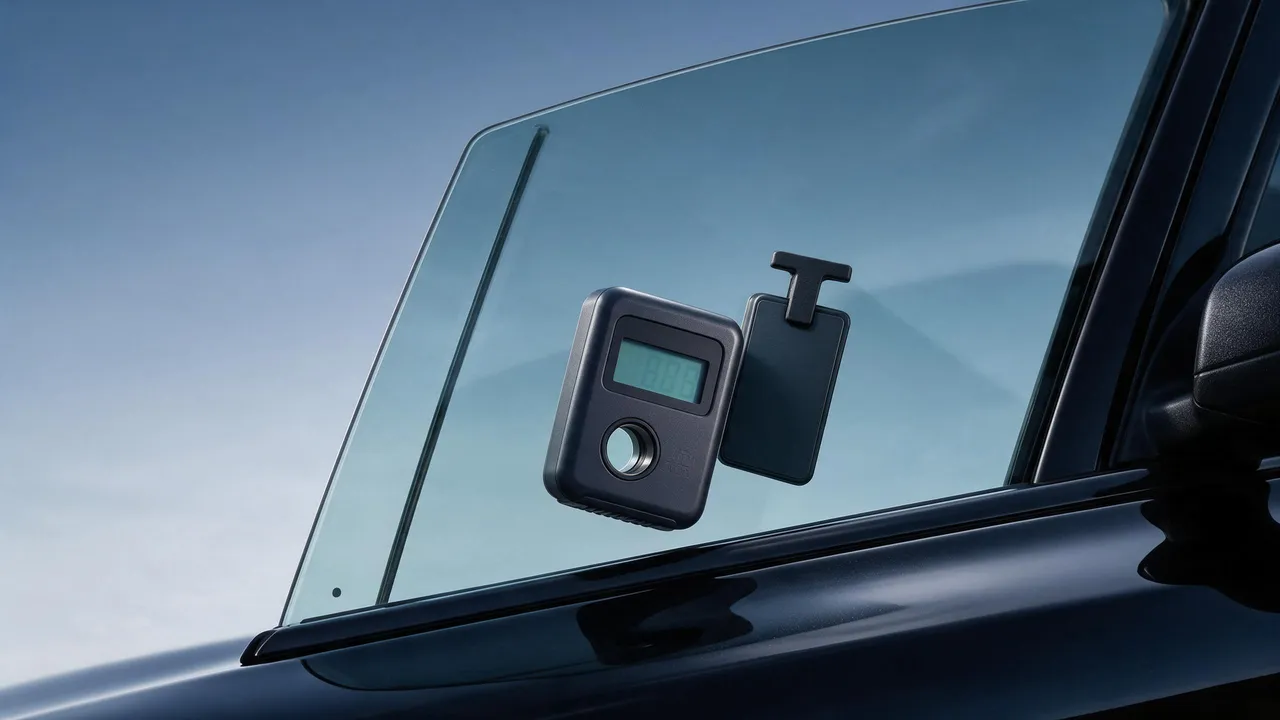
Short answer: VLT is the percentage of visible light transmitted by the specimen being assessed. For an installed tint, distinguish the glass-plus-film result from a film’s stated value. A 70% film on 75% glass gives roughly 52% in a simple estimate, not 70%. Check the actual installation and applicable rules before making a compliance claim.
A film’s optical performance does not by itself establish whether its installation is permitted. Requirements depend on the jurisdiction, vehicle category, window position and any applicable exceptions. Responsibility and penalties must be checked locally rather than assumed to fall on one party everywhere.
This guide explains VLT, a simple glass-and-film estimate, measurement records, application-based selection and wording that separates measured performance from legal conclusions.
On this page
What VLT measures
Visible light transmission is the ratio of transmitted to incident visible light, expressed as a percentage. The result depends on the specimen and the method’s spectral weighting, illumination and measurement geometry. ISO 3538 concerns optical test methods for vehicle safety glazing; ASTM D1003 concerns haze and luminous transmittance of transparent plastics. Naming a method does not establish roadway approval or interchangeability between different test configurations.
Three distinctions help explain the figures to customers:
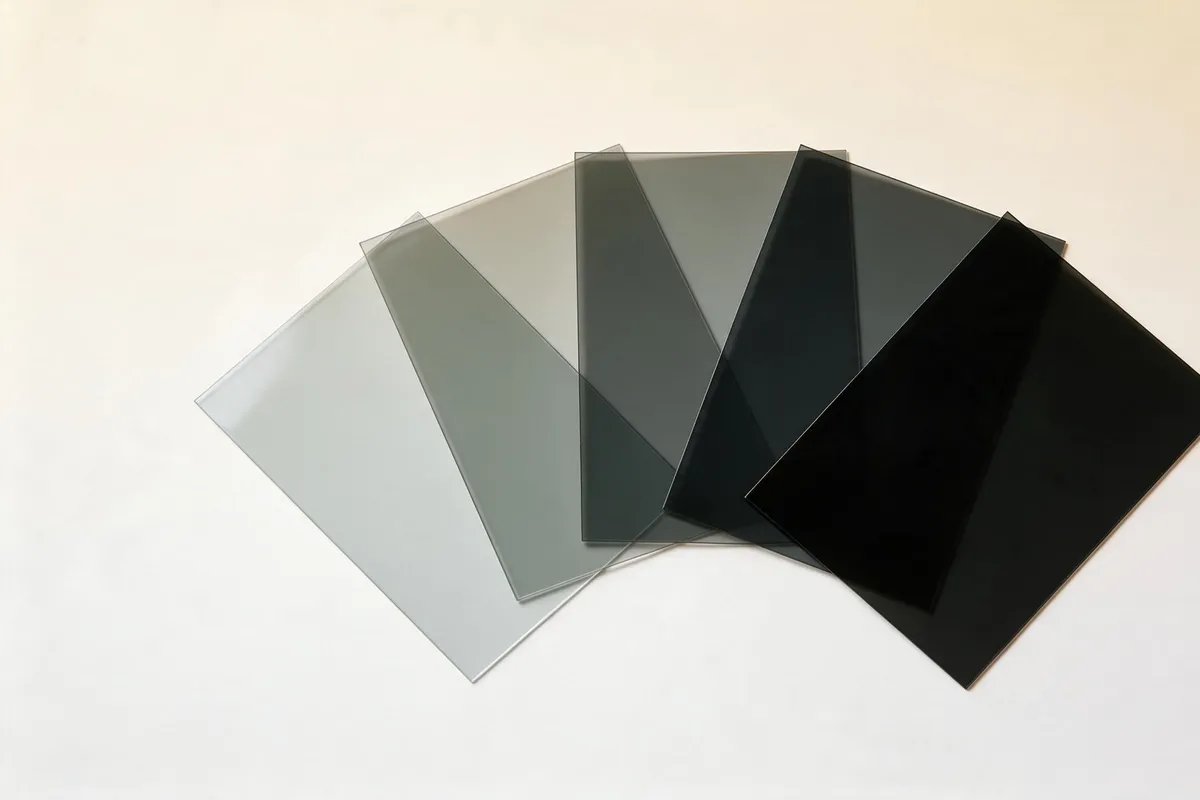
- VLT and visual darkness are different. Films with the same VLT may look different because of color, reflection and haze. For example, two 35% films can have different appearances; appearance alone cannot confirm transmission.
- Measure the installed combination. A datasheet may describe film alone or film on specified reference glass. Check the specimen and method before comparing it with the vehicle’s glass-plus-film reading.
- Glass already affects transmission. Factory glazing has its own VLT; privacy glass may already be below 30%. Use the actual reading, not an assumed clear-glass value. The simple estimate multiplies transmission fractions rather than subtracting percentages.
Estimating glass-plus-film VLT
As a first approximation, multiply glass VLT by film VLT, using fractions rather than whole percentage numbers:
Net VLT ≈ glass VLT × film VLT
This is an estimate, not an acceptance test. Reflections, spectral properties and the actual measurement configuration can change the result. The rounded examples below illustrate why film VLT must not be presented as installed-glazing VLT.
| Factory-glass VLT | Film VLT | Approximate combined VLT | How to read the example |
|---|---|---|---|
| 75% (clear-glass example) | 70% | ≈ 52% | Below a hypothetical 70% combined requirement, despite a 70% film label |
| 75% | 90% | ≈ 68% | Below a hypothetical 70% requirement; actual measurement and applicable rules still need checking |
| 75% | 50% | ≈ 38% | Illustrative medium-transmission combination, not an approved window application |
| 25% (privacy-glass example) | 70% | ≈ 18% | Low transmission; check whether the exact window and vehicle application is permitted |
| 25% | 50% | ≈ 13% | Very low transmission; this is not a legal-use recommendation |
A film near 90% on 75% glass still gives only about 68% in this estimate, below a hypothetical 70% combined requirement. Selecting a high-VLT film alone cannot establish compliance. Measure the actual installation and check all rules applying to that window and vehicle.
Measuring the installed glazing
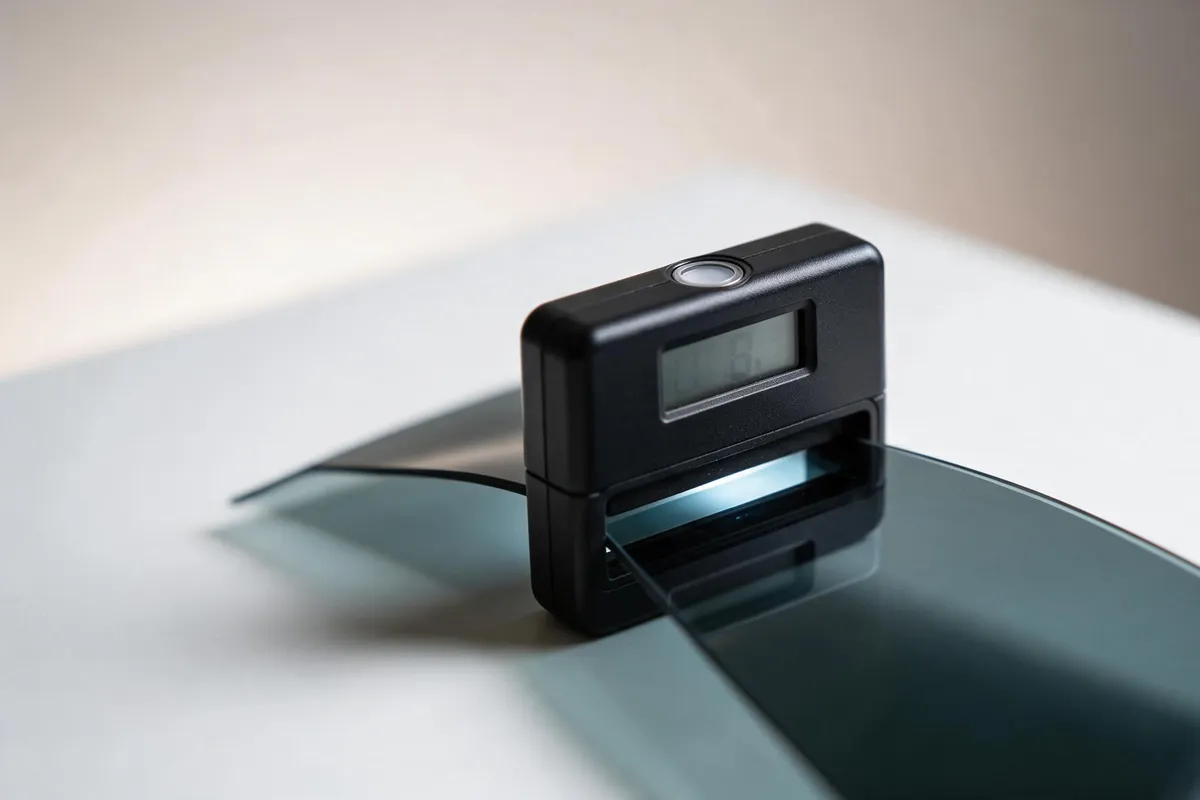
Use an appropriate measurement procedure, keep the readings and explain the record to the customer. The following four points help organize the work; they do not replace the instrument instructions or local inspection procedure:
- Measure the untreated glass first on the intended pane and record the result as a baseline for comparison.
- Use a suitable calibrated meter for automotive glazing. Follow its instructions for reference checks, calibration intervals and measurement conditions, and keep the calibration history.
- Use a consistent measurement position before and after, following the instrument procedure. Avoid opaque borders, frits and antenna lines, and verify correct sensor contact on the pane.
- Measure after installation and record each relevant window separately. Check the procedure’s timing and conditions; front, rear and other glazing positions may have different requirements.
| Variable | Possible effect on the reading | Control measure |
|---|---|---|
| Ambient light | Stray light can bias the reading if the instrument is not used as specified | Follow the meter’s ambient-light and sensor-shielding instructions |
| Glass curvature | Poor sensor contact can produce unstable readings | Use an appropriate head and measurement position for the pane geometry |
| Frits and antenna lines | Opaque or patterned areas may not represent the clear viewing area | Choose a representative area permitted by the measurement procedure |
| Dirty glass | Surface residue can change the measured transmission | Prepare a clean, dry surface according to the meter procedure |
| Meter calibration | Instrument drift or an overdue check can reduce confidence in the result | Use documented reference checks and service intervals specified for the instrument |
Checking the applicable rules
Do not use one VLT threshold for every market or window. Check the current official rules for the jurisdiction, vehicle category, glazing position and installation activity. In the US, distinguish federal business obligations from state vehicle-use rules; in France, Japan and Saudi Arabia, consult the relevant official road-vehicle or traffic requirements rather than importing another market’s threshold.
- Front side windows may be subject to specific visibility and transmission requirements. The 70% examples in this guide are illustrative, not a universal authorization or a rule for every vehicle.
- Rear side and rear windows can have different rules from the front. Check any transmission, mirror, visibility, vehicle-category and inspection conditions instead of assuming they are unrestricted.
- Windshield requires a position-specific check. Top-band permissions, markings, visibility requirements and exceptions vary; do not assume a film is allowed simply because it is clear.
- Commercial and passenger-carrying vehicles may have category-specific requirements or exceptions. Identify the vehicle’s actual classification.
- Medical exceptions must be checked with the competent authority. Eligibility, permitted glazing and required documentation differ by jurisdiction.
Three practical checks for businesses serving several markets:
- Verify any “legal tint” label. Request the test method, film VLT, reference-glass specification and applicable application scope. Then assess the actual installation.
- Maintain a market-specific reference sheet. Record the jurisdiction, vehicle and window categories, relevant requirements, official source, version date, documentation and enforcement body. Recheck before making a current claim and whenever the rules change; an annual review alone may miss a change.
- Explain the measured values and applicable limits. If the requested installation does not meet the applicable requirements, do not present customer preference or a signed acknowledgement as permission to proceed. Record the discussion and decline the non-compliant application.
Building an application-based product matrix
Organize the product range around the actual glazing and use conditions, not a promised universal number of shades. The film-VLT bands below are selection examples, not legal thresholds or guaranteed installed values.
| Application to assess | Illustrative film-VLT band | Selection checks |
|---|---|---|
| Front side glazing, where the chosen application is allowed | 85–90% | High-transmission option; measure combined VLT. This band does not guarantee a 70% installed result |
| Rear side glazing, subject to local conditions | 35–50% | Assess privacy and solar performance only within the permitted application scope |
| Rear window | 35–50% | Check permitted transmission, demister and antenna compatibility |
| Sunroof / panoramic roof | 5–20% | Confirm the roof-glass and film specification, thermal compatibility and applicable rules; do not assume exemption |
| Windshield: permitted area to confirm | Check the applicable rule | Check any top-band, marking, visibility and vehicle-category conditions before selecting film |
High VLT and solar performance are separate properties. Compare the selected product’s VLT, infrared metric, wavelength or band, and TSER under stated test conditions. A light appearance does not prove a fixed heat-rejection result or legal suitability.
Keeping installation records
Keep a clear record of the selected product and measured installation. The following four categories can support traceability and customer communication; they do not guarantee an inspection result or determine liability:
- Before-and-after readings for each relevant window, with instrument model and calibration details.
- Film identification including product code, batch, stated film VLT, specimen configuration and datasheet version.
- Customer acknowledgement of the recorded measurements and any windows left untreated to meet applicable requirements. This does not replace compliance or waive legal duties.
- Photographs of the finished glazing where appropriate. Collect vehicle identifiers only when needed for a defined purpose and handle access and storage under applicable privacy requirements.
Link the installation record to the relevant product and warranty file using an appropriate retention policy. A record from two years earlier may help explain the work, but it does not guarantee the outcome of a dispute or set a universal retention period.
Explaining tint without unsupported claims
Avoid unsupported statements such as “this is legal everywhere” or “this blocks 99% of heat.” Legal suitability depends on the application and jurisdiction. Infrared rejection at one wavelength is not the same measurement as total solar energy rejection.
Use measured, scope-specific wording:
- “These are the readings on this glazing before and after installation. Check them against all requirements that apply to this vehicle and window.”
- “The infrared value is stated for the method and wavelength or band identified in the report. Check TSER separately for total solar performance.”
- “We can assess a high-VLT option for this application, then measure the installed combination and confirm the applicable requirements before making a compliance statement.”
Apply the same discipline to datasheets: request the test standard, specimen or reference-glass configuration and measurement conditions. A figure without this context is not sufficient for a like-for-like comparison. The evaluation approach is discussed in the comparison of window-film technologies.
Frequently asked questions
What does VLT mean for window film?
VLT means visible light transmission: the percentage of visible light passing through the specimen. Check whether a product value is for film alone or film on reference glass. An installed-glazing assessment uses the relevant glass-plus-film result and applicable measurement procedure.
Does a 70% film give 70% VLT on the vehicle?
Not necessarily. The simple estimate multiplies glass and film transmission fractions: a 70% film on 75% glass gives roughly 52%, not 70%. Treat this as an illustration, then measure the actual installation and check any applicable requirement.
How is VLT measured?
Use a suitable calibrated transmission meter and the applicable glazing procedure. Follow its instructions for sensor position, glass preparation, ambient light and reference checks; record the specimen and measurement conditions.
Do front and rear windows have the same rules?
Do not assume so. Requirements may differ by window position, jurisdiction, vehicle category, mirrors and permitted exceptions. Check the current official rule for the exact application; rear glass is not universally unrestricted.
Is a medical exception available for darker tint?
Only if the competent authority’s rules provide for it and the person, vehicle and glazing meet the conditions. Check the required approval or documentation; do not assume a medical note automatically permits the requested installation.
Does ceramic technology itself confer legal permission?
No. A ceramic label does not establish compliance. Check the installed transmission and every other applicable condition for the vehicle and window, rather than treating the film technology or heat-rejection figure as an exemption.
What if a customer requests a non-compliant installation?
Decline the application that does not meet the applicable requirements and keep an appropriate record. Customer preference does not by itself authorize the work. Check local duties and consequences with qualified advice where needed; no single penalty or liability rule applies everywhere.
A measurement-led tint program
Measuring, documenting and explaining VLT can support responsible selection of high-transmission film. It helps customers compare options, but does not guarantee that every installation will pass inspection or prevail in a dispute.
Distributors can assess transmission bands for their actual markets rather than stock only darker films. CHISI’s manufacturing and R&D capabilities include window-film coating and lamination. The OEM and ODM catalog presents construction and VLT options for private-label discussions. For a dealer or distributor program, contact our team with your market, target windows and required VLT bands. Confirm the selected product specifications, test basis and applicable commercial terms.