
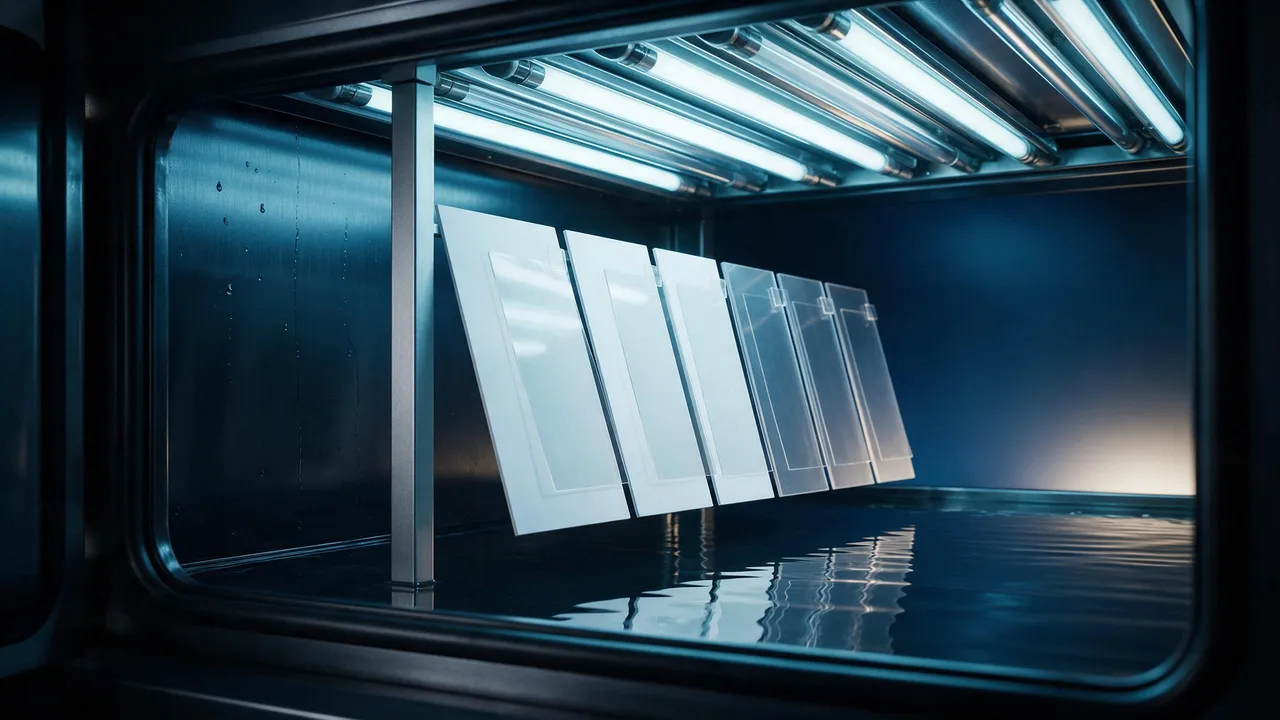
Short answer: UV absorbers and hindered amine light stabilizers (HALS) address different parts of light-induced degradation. Absorbers take up selected UV wavelengths and dissipate energy; HALS can interrupt radical reactions through a regenerative cycle. Neither additive name proves a finished PPF’s durability, placement or formulation. Request product-specific aging data with the method and exposure conditions.
Light, heat, moisture, oxygen and contaminants can contribute to yellowing or gloss change. A stabilizer package is one part of the complete film system, not a substitute for suitable resin, coating and adhesive. Ask what the measured finished-film performance shows rather than accepting an additive checklist as proof.
This guide explains complementary stabilization mechanisms and how to read aging results. Exact additive chemistry and layer placement must not be inferred for an undisclosed product.
On this page
- 1. Light degradation and complementary stabilization
- 2. UV absorbers and energy dissipation
- 3. HALS and radical reactions
- 4. Why an additive name is not qualification
- 5. Comparing the two stabilizer classes
- 6. Accelerated aging methods
- 7. Aging data to request
- 8. Coating and layer compatibility
- 9. FAQ
- 10. Talk to our materials team
Light degradation and complementary stabilization
Absorption of suitable UV wavelengths by susceptible chemical groups can initiate degradation. Radical reactions and oxidation may then alter appearance or mechanical properties. The outcome depends on the material, wavelength and exposure environment; not all yellowing or haze has one UV-only cause.
UV absorption and radical stabilization can complement each other, but formulation must consider compatibility, concentration and the intended exposure. Some systems use additional stabilizers. The presence or absence of one named class alone does not establish a film’s qualification or predict failure.
UV absorbers and energy dissipation
A UV absorber takes up radiation over a characteristic absorption band and releases the energy through relaxation, commonly as heat. Its effectiveness depends on spectrum, concentration, optical path and compatibility. Absorption is not the same as consuming one additive molecule for every photon, nor does it identify the layer used in a particular PPF.
Stabilizers may be used in a coating, substrate or other compatible layer according to the film design. A surface coating also has mechanical and optical requirements. Do not describe every CHISI film as using one double-layer architecture or a topcoat-only absorber package without product-specific evidence.
HALS and radical reactions
HALS are used primarily to inhibit radical-driven degradation rather than to absorb the incoming UV band. Their reaction sequence can regenerate active species, enabling repeated stabilization cycles. This is a chemical reaction cycle, not a claim that molecules travel through the film or remain effective indefinitely.
A regenerative mechanism can support efficient light stabilization, but the package can still lose effectiveness through degradation, migration or incompatibility. Compatibility with other additives and coating cure matters. Do not infer a universal lifetime advantage over every absorber or antioxidant from the mechanism alone.
Why an additive name is not qualification
An additive declaration is a starting point, not the complete durability evidence. Consider the following three formulation and testing questions.
An absorber can be lost or changed through migration, extraction or chemical degradation. That is different from saying every absorbed photon consumes it. Evaluate retention and performance after the relevant exposure; combining additives does not automatically guarantee longer service life in every system.
UV absorption does not by itself control every thermal or oxidative pathway. Select light stabilizers, antioxidants and the resin system for the expected environment, then assess the complete laminate. The yellowing guide discusses why resin chemistry also matters. A broad chemical label, including an isocyanate or polyol family, is not a finished-film yellowing guarantee or a disclosure of every product’s recipe.
Comparing the two stabilizer classes
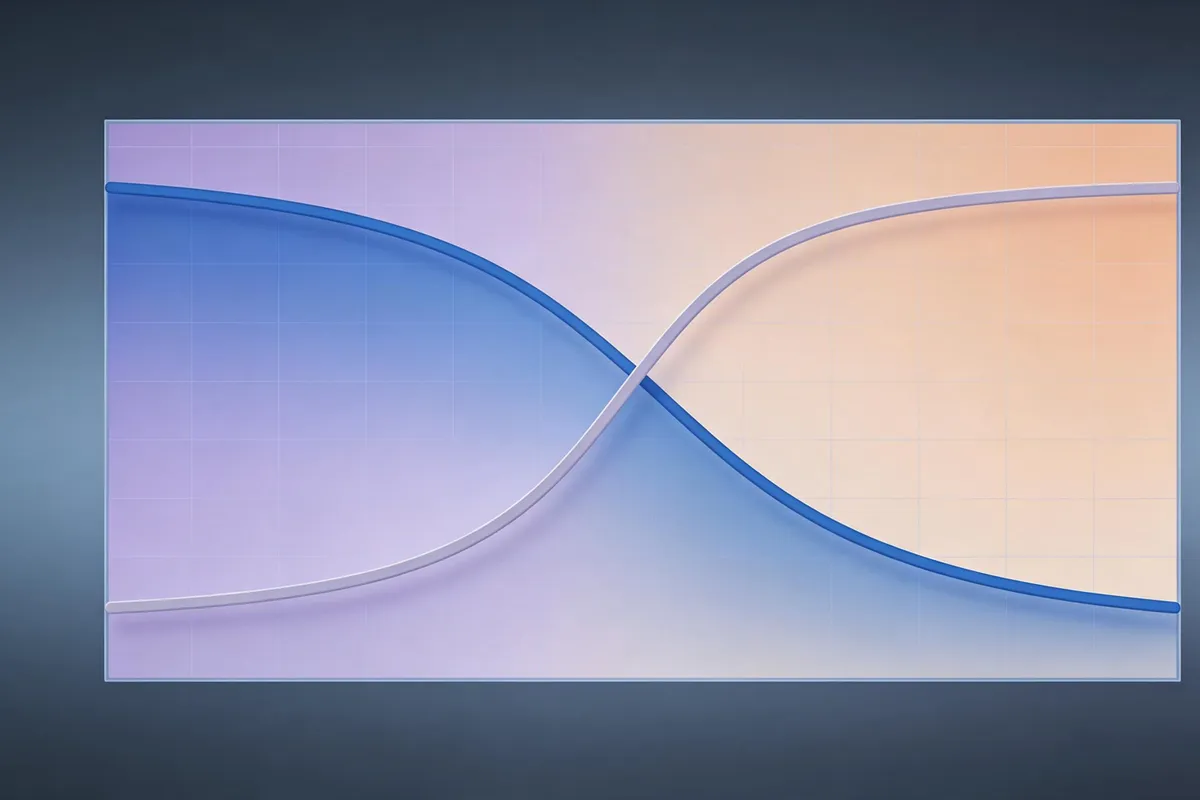
Use this table to distinguish mechanisms, not to prescribe the same additive package or location for every PPF. Visible defects alone cannot identify which stabilizer is absent.
| Class | Mechanism | Placement to confirm | Assessment if performance changes |
|---|---|---|---|
| UV absorber | Absorbs selected UV wavelengths and dissipates energy | Compatible layer or layers defined by the formulation | Check spectrum, loading, retention and other causes of discoloration |
| HALS | Inhibits radical reactions through a regenerative cycle | Compatible coating or bulk layer, as designed | Assess oxidation and compatibility; haze is not a unique HALS diagnosis |
Accelerated aging methods
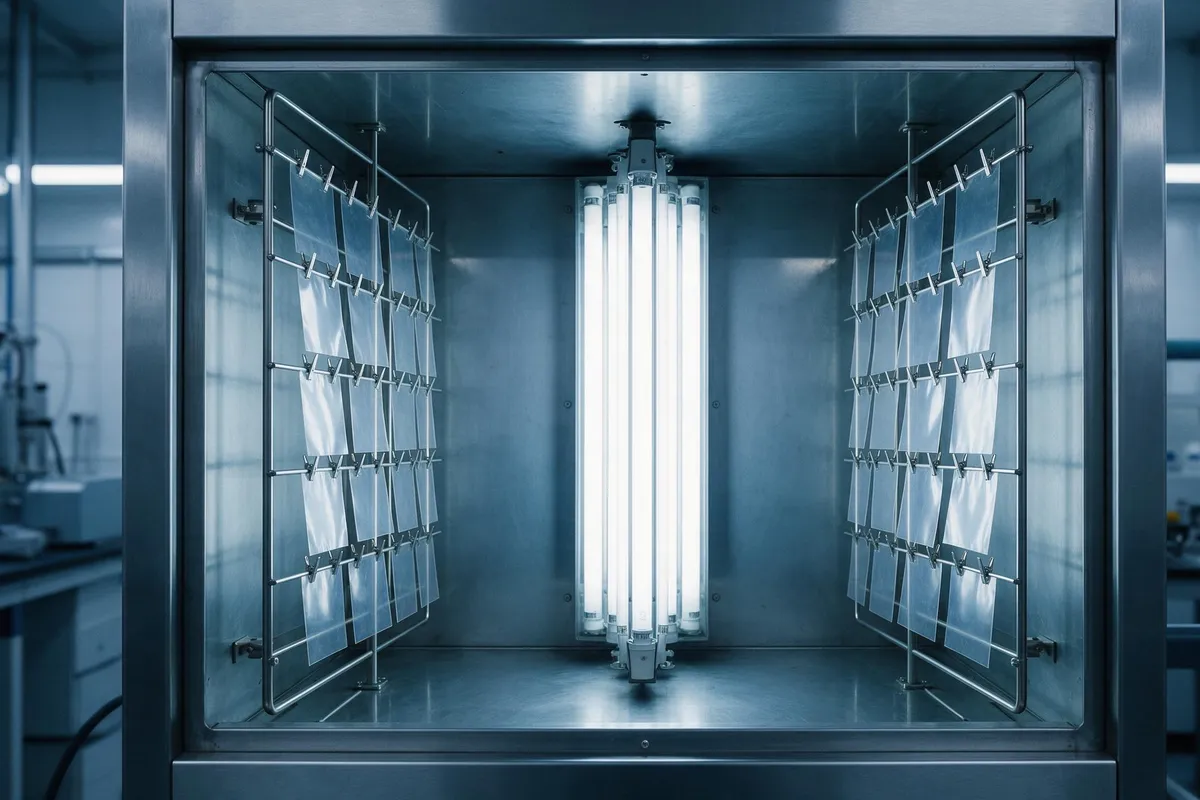
Accelerated exposure helps compare defined systems without waiting for a full outdoor service period. Choose methods for the expected failure mechanisms and validate any relationship to field performance separately.
| Method | Exposure elements | Limitations and conditions |
|---|---|---|
| QUV / fluorescent UV exposure | Defined lamp, irradiance and moisture cycle | Not the full solar spectrum; do not assume a lower heat load than outdoor service |
| Xenon-arc exposure | Filtered xenon light chosen for the intended spectrum | Filters, irradiance, temperature and moisture cycle affect results |
| Other UV-chamber protocol | Specify lamp, spectrum, dose, temperature and moisture | May overlap the fluorescent-UV category; not automatically an independent third test |
Our R&D and factory can discuss available aging methods for a project. Request the actual specimen, method and exposure record rather than assuming that two test names automatically qualify a film or predict outdoor life.
Aging data to request
Request baseline and exposed color and gloss data with a named method, cycle and duration. The values below are source discussion examples, not verified current measurements for every CHISI color film. Define an acceptance criterion for the exact product rather than copying an isolated number into an order.
| Data point | What it describes | Definition and conditions to request |
|---|---|---|
| Δb*: change in the yellow–blue coordinate | A signed coordinate change, not total color difference | Compare finished-film performance before and after a defined exposure. Record the exposure, sample construction and measured change together. |
| ΔE: total color difference under a specified formula | Overall difference in the chosen color metric, not a universal visual threshold | State the formula, illuminant, observer and measurement geometry |
| Gloss retention | Change in gloss after the specified exposure | Compare finished-film performance before and after a defined exposure. Record the exposure, sample construction and measured change together. |
| Test method, cycle and duration | Needed for a meaningful comparison with matched specimens | Name the equipment, lamp or filter, exposure conditions and hours |
These are not a cross-method ranking or a current all-product test report. Confirm the sign convention, specimen and complete cycle before agreeing an exact product criterion; do not convert hours into warranty years.
Coating and layer compatibility
The complete layer system matters. Stabilizers can act in compatible layers selected by the formulation, while the coating also needs suitable adhesion, appearance and scratch or stain performance. Neither a topcoat label nor absorber in the bulk alone determines UV transmission or durability; evaluate the complete product.
Ask how the specified coating and base are qualified together, without requiring disclosure of a proprietary recipe or assuming a single- or double-layer name proves performance. For colored films, also assess color change under the stated measurement conditions, as discussed in the color-matching guide.
Frequently asked questions
Is naming a UV absorber enough to qualify a film?
No. Ask for complete-product exposure data and compatibility evidence. Absorbers and HALS can be complementary, but an absorber is not necessarily consumed by each photon, and adding two classes does not guarantee a particular lifetime.
What does HALS mean?
Hindered amine light stabilizers are used to inhibit radical-driven degradation. Their regenerative reaction cycle differs from UV absorption. Effectiveness still depends on the polymer, formulation and exposure; regeneration does not mean unlimited service life.
Where should stabilizers be placed?
Placement is a formulation decision for compatible coating, substrate or other layers. Do not assume every PPF uses topcoat-only absorption. Request product performance and the information the supplier can disclose, not an inferred recipe.
Which aging method should be used?
Choose the method for the material, intended exposure and property being assessed. Fluorescent UV and filtered xenon have different spectra and cycles; “UV chamber” may overlap one category. No test count or method name alone establishes service life. Use matched specimens and report the actual conditions.
What Δb criterion should be specified?
Define the coordinate system, sign convention, specimen and exposure first. State whether a signed change or absolute magnitude is being limited.
Does the base resin affect yellowing?
Yes, resin chemistry is one influence alongside coating, adhesive, additives and exposure. Do not infer the performance of a finished film from an isocyanate or polyol family alone, or transfer one series’ yellowing data to another. Confirm the exact product’s report and scope.
Why report exposure duration with the value?
A value has meaning only with the exposure and measurement conditions. Compare changes from baseline with method, cycle and duration; do not turn test hours into outdoor years or warranty.
Can an OEM project specify stabilization targets?
Discuss the required exposure and appearance targets, compatible construction and available test evidence. Agree the feasible specification and batch checks with the supplier. This does not disclose a particular additive recipe or guarantee any requested target before validation.
Talk to our materials team
Evaluate UV stability as a complete product system. Ask for the named exposure method and measured property changes rather than relying on one additive name or one unqualified aging number. Agree any acceptance target against the exact material and intended use.
Our R&D and factory can discuss aging-test requirements and the reports available for the exact film. Confirm the method and conditions for Δb*, ΔE and gloss measurements. To discuss an OEM project, contact our team with the exposure environment and target service requirements.