
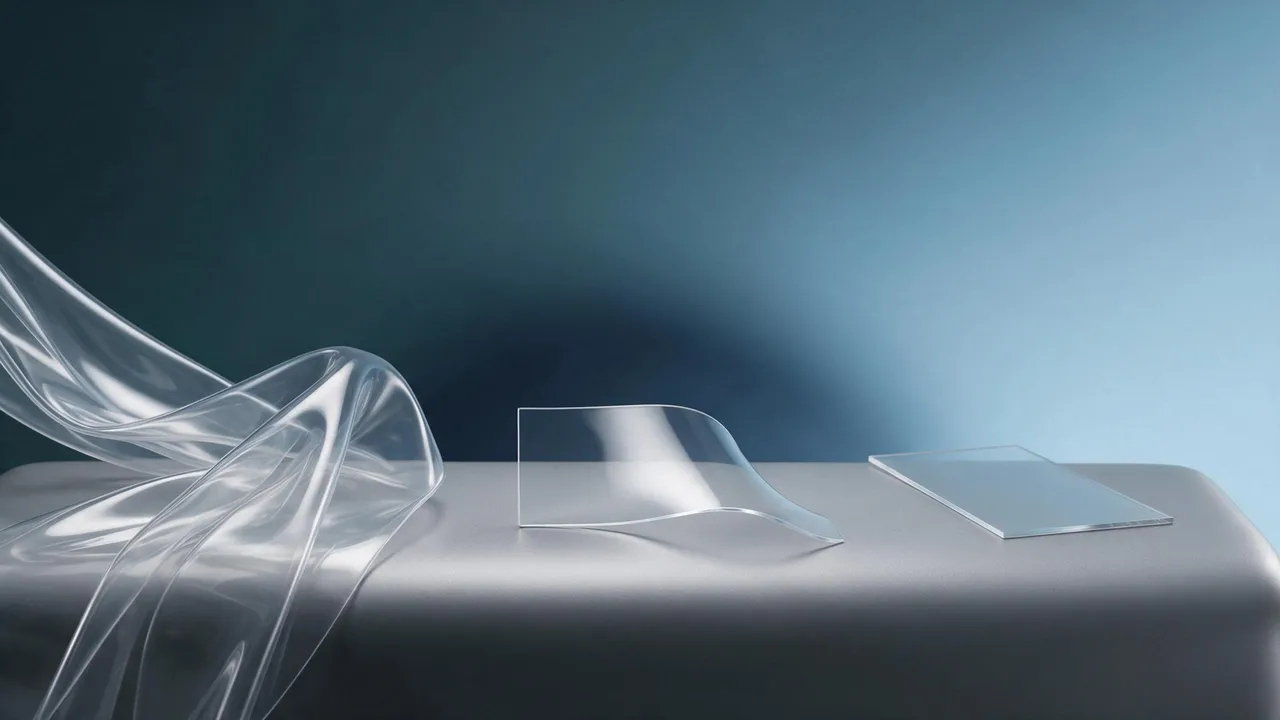
Short answer: Indentation hardness, elastic modulus and tensile stress at a specified elongation are different quantities. In elastomer data, “100% modulus” commonly means stress at 100% elongation, not the slope of the stress–strain curve. None of these values alone ranks stone-chip protection. Compare the complete film under matched test conditions and specify impact, puncture and installation performance separately.
A Shore value is useful only with its scale, specimen and measurement conditions. It cannot by itself predict behavior on a bumper or mirror cap. Buyers should distinguish indentation of the material from tensile response and from a finished coating’s pencil-hardness result.
This guide separates hardness from tensile properties and explains what to request in a purchase specification. Its hardness bands and panel examples are teaching references, not measured CHISI ranges or universal product-selection rules. Formulation, film thickness, coating, adhesive and test conditions all affect the result.
On this page
- 1. Hardness, elastic modulus and stress at elongation
- 2. Mechanical response and stone-chip protection
- 3. Why thickness and hardness are not an impact rating
- 4. Reading illustrative hardness bands
- 5. Evaluating film by panel
- 6. Mechanical properties for a purchase specification
- 7. OEM and ODM specification discussions
- 8. FAQ
- 9. Talk to our materials team
Hardness, elastic modulus and stress at elongation
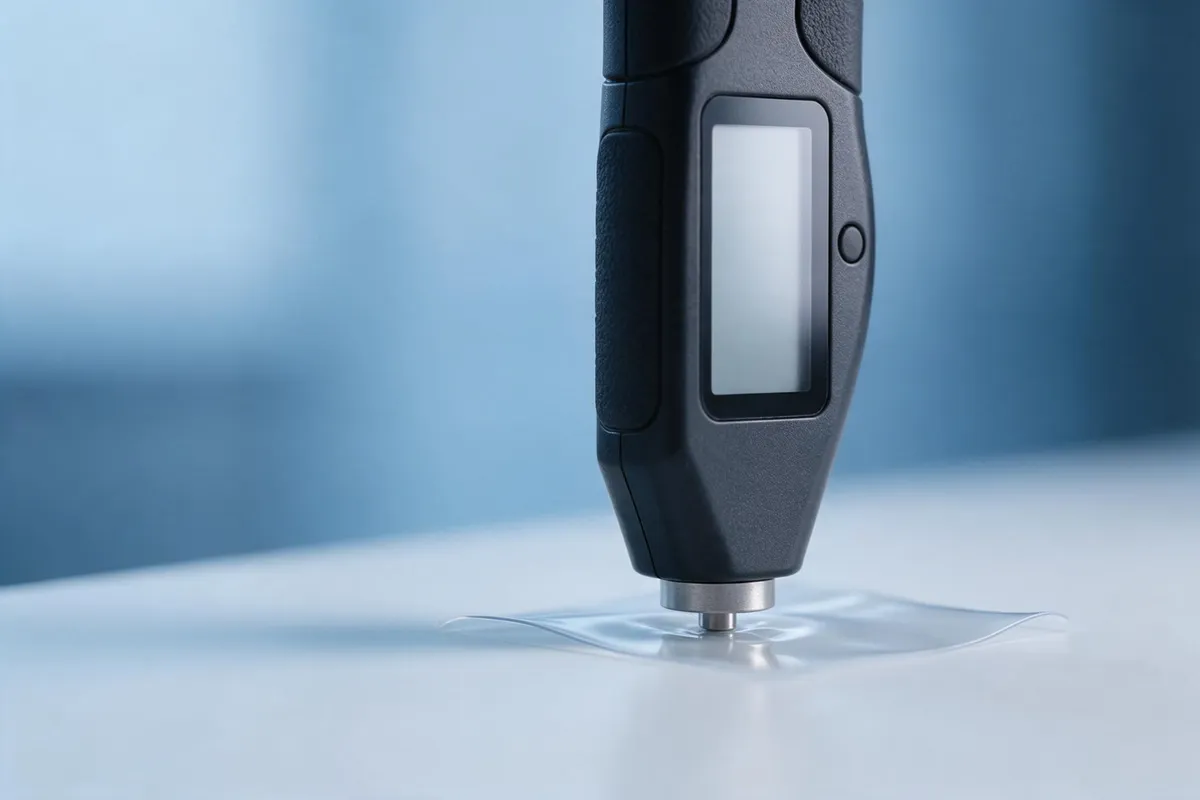
A durometer measures indentation under specified force and time. Shore A and Shore D use different measurement systems and are not interchangeable numbers. A label such as “90” is incomplete without the scale. For thin film, also confirm specimen thickness, support or stacking and method suitability; a casual reading on a single film is not automatically a valid standard result.
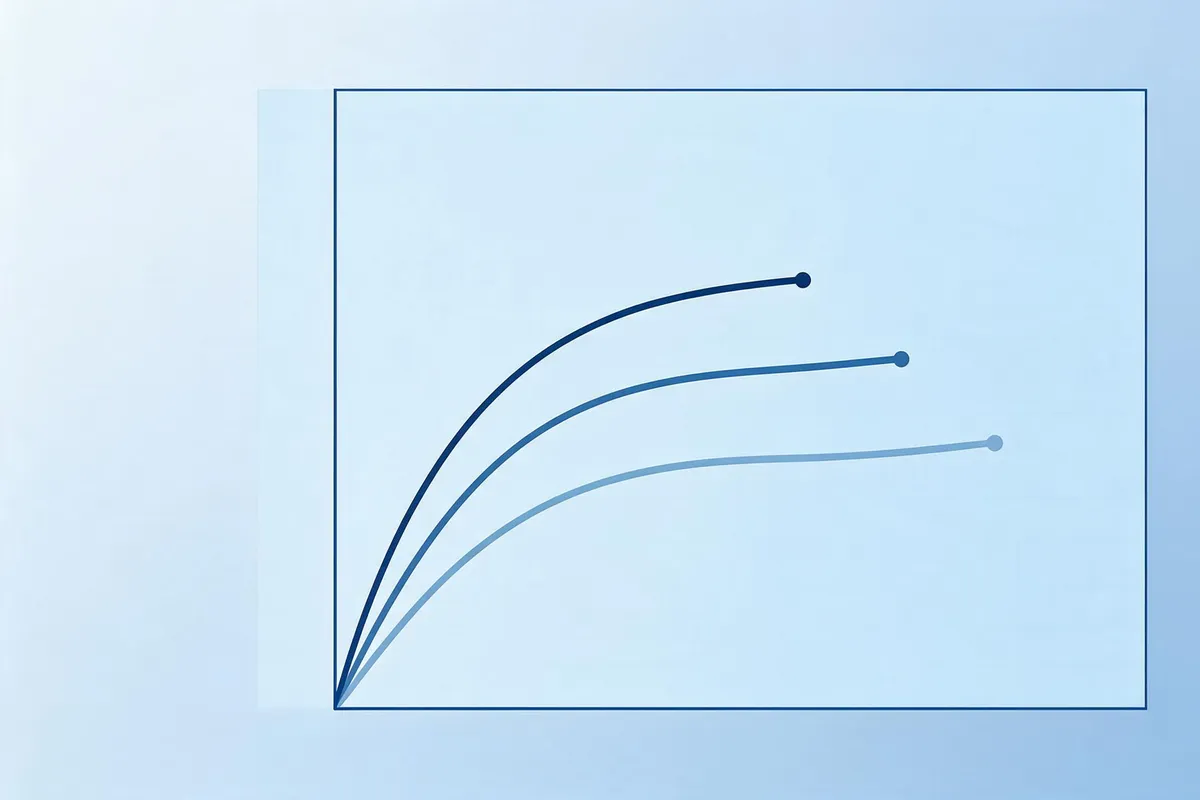
Elastic modulus describes a stress–strain slope under a stated definition. “100% modulus” in elastomer usage instead denotes tensile stress at 100% elongation, when the gauge length is twice its original value. It is a stress quantity, commonly reported in MPa, not a dimensionless value or an initial elastic slope. Hardness and this stress can correlate within a material family without being equivalent.
Request the scale and test setup for hardness and the defined tensile property with its conditions. These data support material comparison, but do not alone predict installation, absorbed impact energy or protection of paint.
Mechanical response and stone-chip protection
Impact performance depends on the complete film, adhesive, coating, substrate and impact conditions. Deformation, load distribution and energy dissipation all matter. A Shore reading is not a stone-chip test and cannot establish which film protects a particular paint system better.
A more compliant film may deform and distribute a load differently, but that does not guarantee less paint damage, slower recovery or lower puncture resistance. Those outcomes must be measured for the actual construction and loading rate. Curved-panel conformability is a separate application assessment.
A higher hardness may accompany different wear or puncture behavior in a particular formulation, but is not proof of better abrasion resistance, gloss or cleaning. Nor does it automatically mean more stress reaches the paint. Compare matched tests on the intended film-and-substrate system.
Why thickness and hardness are not an impact rating
Thickness can affect puncture, bending and energy response, but does not replace impact testing. Stiffness alone does not determine how much energy is dissipated or transferred to paint. Avoid a general claim that a thicker film is always better or always worse; compare the relevant failure mode under matched conditions.
TPU contains hard and soft segments whose chemistry, organization and interactions influence its mechanical response. Polycaprolactone is one possible polyol route, not the identity of every TPU. Elastic recovery of the base material is also different from scratch recovery of a finished coating; neither alone establishes impact performance.
Changing segment chemistry or thickness can alter stiffness and failure behavior, but the direction depends on formulation and test conditions. Do not generalize one PCL formulation’s hydrolysis behavior to all CHISI films. The hydrolysis guide discusses why the exact resin and exposure conditions matter. Treat thickness, chemistry and the complete film’s test results as separate specification items.
Reading illustrative hardness bands
They do not establish a fixed modulus or impact ranking. Its 23 °C and 50% RH are example comparison conditions, not a complete test method. Ask for measured values with specimen, rate, conditioning and property definition.
Record the specimen, measurement method, instrument settings and test conditions. Compare results obtained on the same basis.
Select against the actual application and measured properties, not the highest Shore number. Test the complete film at relevant conditions and confirm repeatability before choosing a grade.
Evaluating film by panel
A bumper, hood, door and mirror cap present different geometry and exposure. The following panel examples suggest questions to investigate, not a universal hardness prescription or a substitute for product qualification.
| Panel example | Hardness reference to evaluate | Application questions |
|---|---|---|
| Front bumper | Record the specimen, measurement method, instrument settings and test conditions. Compare results obtained on the same basis. | Assess impacts, local deformation and curved geometry |
| Hood and front fascia | Record the specimen, measurement method, instrument settings and test conditions. Compare results obtained on the same basis. | Assess impact, puncture and appearance on the actual panel |
| Door and rocker panel | Record the specimen, measurement method, instrument settings and test conditions. Compare results obtained on the same basis. | Test scuffing, abrasion, finish and cleaning compatibility |
| Mirror cap | Record the specimen, measurement method, instrument settings and test conditions. Compare results obtained on the same basis. | Check compound curvature, local thinning and edge stress |
No middle band is automatically safe for all four locations. A single-film program needs application testing across its intended panel mix; separate kits can use different specifications where supported by evidence, not just a hardness label.
Mechanical properties for a purchase specification
Request the actual property, test method, specimen, temperature, humidity, conditioning and extension rate. Results from different conditions need not be comparable. A resin data sheet is not automatically a finished-film report, and tensile data alone do not qualify stone-chip protection.
| Property to specify | What the measurement describes | Value and conditions to request |
|---|---|---|
| Tensile strength | Maximum tensile stress under the selected test; not tear propagation | Record the specimen, measurement method, instrument settings and test conditions. Compare results obtained on the same basis. |
| Elongation at break | Extension at rupture in the specified test, not an installation allowance | Request the measured percentage for the exact specimen |
| Stress at 100% elongation (“100% modulus”) | Stress at one defined elongation; not a direct impact-energy measurement | Record the specimen, measurement method, instrument settings and test conditions. Compare results obtained on the same basis. |
| Tear strength | Resistance to propagation of a specified cut or notch | Confirm the method, geometry and reported unit, such as kN/m |
OEM and ODM specification discussions
Discuss hardness, tensile response, thickness and construction as a combined specification. The available resin, coating and adhesive options depend on the project and do not disclose every current product’s formulation. Define climate and panel requirements without assuming that cold always means softer or that hot conditions always favor a harder film. The OEM and ODM catalog presents customization topics, while the cast versus calendered guide discusses processing context. Neither processing name guarantees uniform properties across a roll.
Frequently asked questions
Does higher Shore A always mean better protection?
No. Hardness alone cannot rank impact, puncture, abrasion or paint protection. Compare complete-film tests under matched conditions and evaluate installation on the intended panels.
How do Shore A and Shore D differ?
They use different indentation systems for different material responses. State the scale with a value such as “90”; do not convert between the scales by assuming a common numerical overlap. Also report specimen preparation and measurement time.
Why request stress at 100% elongation as well as hardness?
It describes tensile resistance at a defined strain, which an indentation value does not. It is not the initial elastic modulus or an impact-energy result. Compare the same property at the same temperature, extension rate and specimen conditions.
Does greater thickness always improve impact resistance?
No universal rule follows from thickness alone. Thickness, formulation, coating, adhesive and substrate all affect the failure response. Use a defined impact or puncture test rather than inferring performance from thickness or stiffness.
Which hardness should be chosen for a mirror cap?
Evaluate the actual film on the compound curve, including local strain, thinning, edge stress and the permitted installation method. Lower Shore A alone does not guarantee conformity, freedom from lifting or better impact protection.
Should a program specify different films by panel?
Possibly, if application tests justify it. A single-film program should also be qualified across its intended panels.
Which conditions belong with mechanical data?
Report the method, specimen dimensions and direction, conditioning, temperature, humidity and extension rate. Identify whether the sample is resin, substrate film or a finished laminate. Compare like-for-like properties rather than mismatched numbers.
Can an OEM program adjust hardness?
Discuss the feasible hardness and tensile-property ranges alongside thickness, resin, coating and adhesive. Confirm the proposed construction and test evidence before agreeing specifications; customization does not establish the undisclosed formulation of an existing SKU.
Talk to our materials team
For a particular climate or vehicle mix, share the panel geometry, installation conditions and performance requirements. Discuss a measured property range and qualification plan rather than selecting a film by one hardness number or promising protection from modulus alone.
Our R&D and factory can discuss hardness, tensile, tear and aging-test requirements for a project. Request the exact test method, available report and batch-consistency terms; do not treat a proposed range as a completed product test. To discuss a specification or OEM project, contact our team with your market and the panels you work on.