
Short answer: Chemical resistance is specific to the complete film and exposure. Identify the actual product or mixture, concentration, contact duration, temperature and test method. Assess coating, TPU, adhesive and substrate as appropriate. Compare defined appearance and mechanical changes before and after any specified recovery; a material name or generic “chemical resistant” label is not universal compatibility or a cleaning instruction.
Films may encounter fuels, service fluids, road residues and cleaners. Their formulations and exposures vary, so TPU cannot be ranked universally above other film chemistries. Request evidence for the selected film and actual fluid, including relevant layers and interfaces, rather than relying on a single resistance label.
This guide uses representative exposure groups and test formats, not an exhaustive chemical classification or a CHISI compatibility chart. Actual mixtures need product-specific TDS/SDS and suitable testing. Source examples do not establish safe solvent recipes, contact limits, chemical handling procedures or warranty outcomes.
On this page
Representative chemical exposures
Consider fuels, alcohol-containing or glycol-containing service fluids, and acidic or alkaline products as examples, not three exhaustive attack classes. Gasoline, diesel, brake fluid and washer fluid are mixtures whose composition varies. Their names do not establish polarity, compatibility or the affected layer. Evaluate the identified fluid and film construction.
Swelling, softening, marking and chemical breakdown are different responses, and more than one may occur. A broad chemical class does not predict which will occur in every film. Test the actual contact scenario rather than assuming a brief splash or routine fluid is harmless. The stain-resistance guide discusses related surface effects; visible staining and bulk chemical damage should not be treated as the same endpoint.
Concentration, time and conditions
This is a teaching comparison, not an approved dilution or safe contact time. Identify the alcohol, mixture, concentration basis, temperature and complete test procedure. Response is not determined by a single “dose” number.
Ask which fluid, concentration, contact mode, duration and temperature were tested and which changes were judged. Edge contact and surface contact may differ. A brief exposure is not automatically safe; use the film and chemical manufacturers’ applicable instructions and evidence.
Chemicals, responses and handling limits
The table lists possible concerns, not guaranteed effects or a chemical-handling procedure. Actual product composition, coating and exposure govern evaluation. Obtain relevant film guidance and chemical TDS/SDS before defining a test or response to a spill; no universal wiping, rinsing or neutralization recipe is supplied.
| Chemical or exposure | Composition to identify | Possible response to assess | Handling evidence required |
|---|---|---|---|
| Gasoline or diesel | Actual fuel mixture and additives | Swelling, softening or other change under defined contact | Use applicable fuel and film spill instructions |
| Brake fluid | Identify the fluid chemistry; not every fluid is glycol-based | Appearance and mechanical changes to be tested | Follow fluid SDS and applicable surface instructions |
| Washer fluid | Identify the actual mixture and use concentration | Do not assume routine or dilute use is harmless | Verify film and fluid instructions for the application |
| Acidic or alkaline product | Identity, concentration and complete formulation | Possible surface or bulk change; pH alone is insufficient | Use approved product guidance; no universal neutralization |
Limiting unintended contact matters, but the response to a chemical must follow applicable safety and product instructions. Test the actual coating–substrate–adhesive system and defined exposure. A generic “pass” without conditions is not evidence of universal compatibility.
Immersion, wipe and spot tests
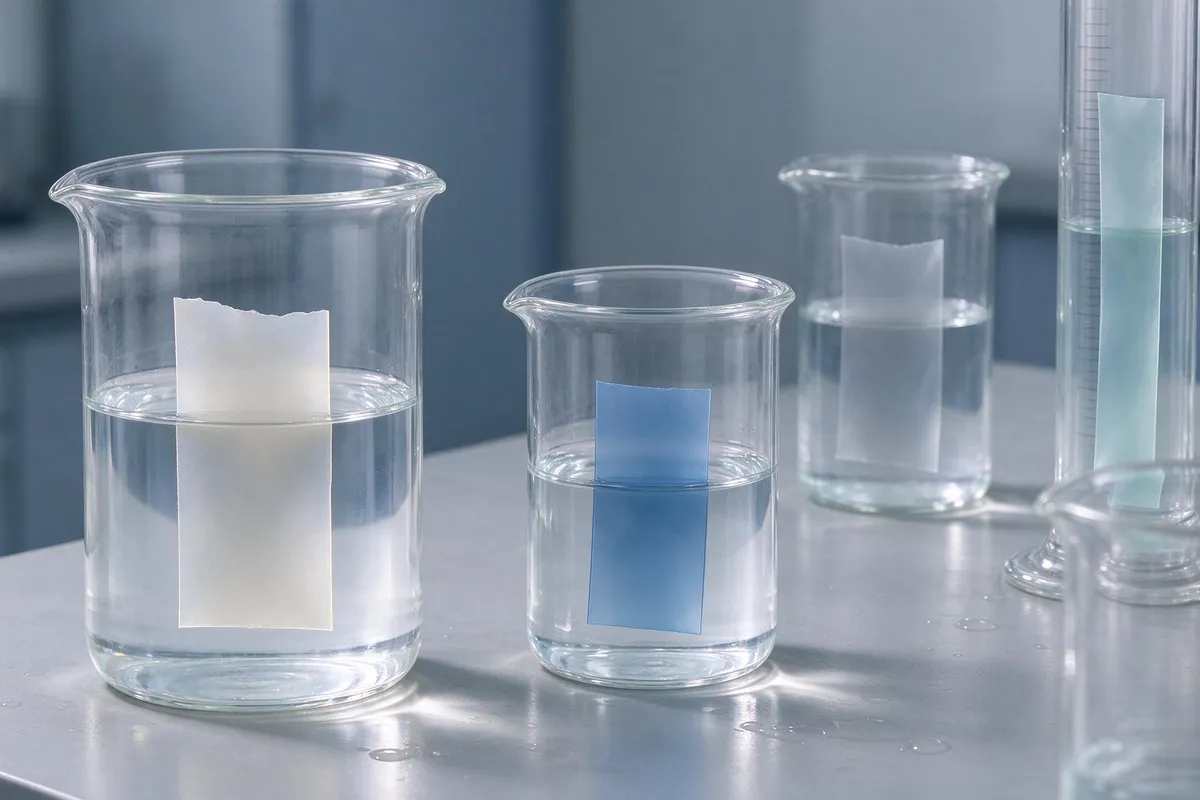
Immersion exposes defined specimen surfaces to a liquid; wiping combines chemical contact and mechanical action; spot testing examines a defined local contact. Specify fluid, amount, pressure or repetitions where relevant, temperature, duration, cleaning and recovery before evaluation. These methods are not a universal severity ranking or interchangeable simulations.
Select the method to answer the actual exposure question and validate its relevance. A spot may help investigate a splash, but no method automatically reproduces field contact. Full-film, supported and installed specimens may give different results. Keep test design separate from field chemical-handling instructions.
| Test format | Contact defined by the protocol | Possible measurements | Limitation |
|---|---|---|---|
| Immersion | Defined liquid exposure and specimen surfaces | Mass or volume change, color and separate tensile properties | Not automatically the most severe field exposure |
| Wipe or rub exposure | Defined fluid and mechanical contact | Appearance, gloss and evidence of surface change | Specify force, medium, passes and recovery |
| Spot or drop exposure | Defined fluid, quantity, area and dwell | Local color, haze, marking and mechanical response | Local result; repeatability needs a controlled method |
Evaluating results
Define endpoints such as color difference, gloss, tensile strength, elongation, mass or volume change. State the color formula and viewing or instrument conditions; there is no universal “low single-digit ΔE is invisible” threshold. Measurements at exposure end and after specified recovery answer different questions. Apparent recovery does not prove every layer is undamaged.
Use the relevant set of properties rather than assigning appearance only to owners and mechanics only to installers. Unchanged color or strength does not exclude other damage. Compare each result with its own baseline and criterion, and investigate cause with additional evidence.
Actual market exposure
Region labels suggest questions, not universal exposure profiles or approvals. Coastal, industrial and hot settings can differ widely by use, fluids and maintenance. Temperature does not accelerate every reaction identically. Establish actual exposures and test relevance rather than assuming a regional name defines the chemical specification.
The following profiles are discussion examples, not prescribed test agents or regional safety standards. Select a justified protocol with suitable laboratory controls and the actual film and fluid information.
| Illustrative setting | Exposure to investigate | Evaluation question |
|---|---|---|
| Coastal use | Actual salt, liquid and edge exposure | Assess the complete system; no salt-spray certification implied |
| Industrial or urban use | Identified deposits, fluids and cleaners | Choose relevant methods; no extreme-pH recipe supplied |
| Hot or dusty use | Actual temperature, chemicals and mechanical contact | Separate chemical and abrasion effects under defined conditions |
Purchasing specification
Record fluid identity and composition, concentration basis, contact mode, duration, temperature, preparation and method. Define any cleaning or recovery and each endpoint’s criterion. Ten and fifty wipe passes are different exposures, not universal SOP choices.
A resistance statement needs these conditions and a defined result. Compare equivalent methods and complete-film constructions; do not use a generic pass, material-brand name or unrelated series test as proof. The OEM and ODM catalog provides project context; actual formulation options and compatibility targets require individual discussion, not disclosure of a CHISI recipe.
Product-specific care
Cleaner formulation, film finish, paint and exposure all matter. A neutral pH alone does not prove compatibility, and “mild” does not define a pH. Follow the actual film, paint and chemical instructions and SDS; do not improvise solvent use, dilution or neutralization. care guide offers related context; apply only the care instructions valid for the selected model and finish.
Installation fluids, residue under edges and later cleaning are distinct exposures. Use approved product-specific application and aftercare instructions; do not introduce a solvent to reposition film or set a universal safe contact time from this article. Keep records for investigation without assigning responsibility in advance.
Frequently asked questions
Is TPU film universally chemical-proof?
No universal compatibility applies. The exact grade, coating, adhesive, substrate, chemical mixture and exposure matter. Request relevant product evidence and instructions; even a short or dilute contact cannot be declared harmless from the TPU name alone.
Why state concentration?
A fluid name does not describe its mixture or exposure. Record concentration and its basis alongside temperature, time, contact mode and method.
Which test can investigate a fuel splash?
A defined spot test may be relevant, but validate fluid, amount, specimen, dwell, temperature and evaluation. Immersion and wiping answer different questions and are not universally ranked. Laboratory protocols do not replace spill-safety instructions.
What does ΔE show?
It describes a color difference under a stated formula and measurement setup. Visibility depends on sample, finish, lighting, geometry and observer; no universal low-single-digit invisibility threshold applies. Compare color with other relevant properties and the agreed criterion.
Why not use tensile retention alone?
Strength, elongation, appearance and dimensional changes can differ. Record each relevant property separately against its baseline, including any specified recovery stage. An unchanged result does not prove every layer or function is unaffected.
How should the target market inform testing?
Identify actual use, fluids, temperatures and maintenance rather than relying on region labels. Select justified tests for the whole system. Coastal, industrial or hot descriptions do not establish standard exposures, regulatory compliance or guaranteed regional suitability.
Can an OEM project target chemical compatibility?
Discuss available options and evidence for the actual product and chemicals. Agree method, conditions and measured criteria before ordering. This does not promise a custom recipe, every chemical rating, an existing report for each SKU or an expanded warranty.
How should a cleaner be selected?
Follow the actual film, paint and cleaner instructions and relevant SDS. Neutral pH or a “mild” label alone does not prove compatibility. Do not infer a solvent recipe, dilution or safe dwell time from this article, or rank cleaning above road exposure without evidence.
Discuss compatibility evidence
Provide the product, intended use, actual fluids and exposure scenario. Discuss suitable available evidence and a defined evaluation, rather than a generic resistance promise. Laboratory results apply only within their documented scope and do not automatically qualify another series or condition.
See the R&D and factory overview for company context, not proof of a chemical-test suite or batch report for every SKU. To discuss evidence or an OEM project, contact our team with the target market and identified chemical products and conditions.