

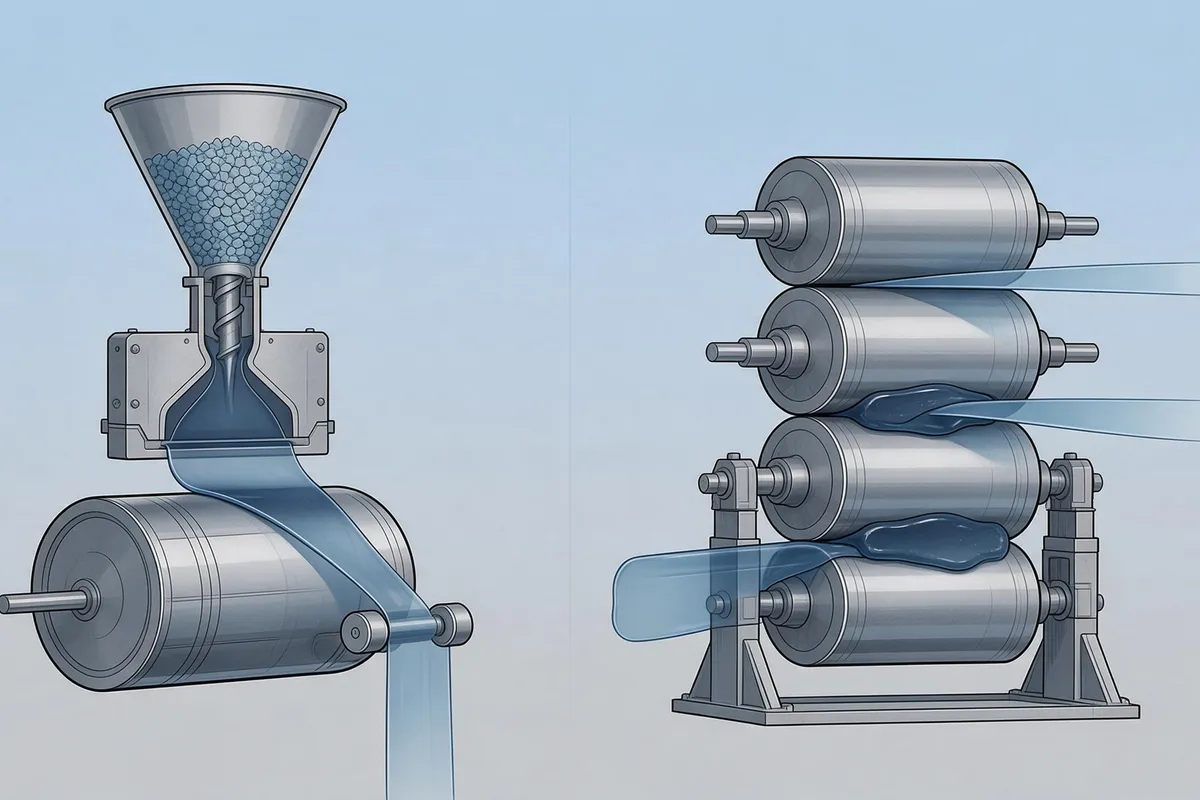
Cast extrusion and calendering are different ways of forming suitable TPU grades. In flat-die cast extrusion, melt leaves a die and is cooled on rolls; calendering forms material through a roll system. Equipment may combine extrusion and rolls, so a roller alone does not identify the route. Compare actual construction, thickness control, optics and qualification results rather than treating either name as a performance guarantee.
This guide explains cast extrusion, blown film and calendering, then sets out how to verify a proposed PPF process. CHISI process descriptions and general supplier literature provide context, not proof that cast always wins on quality or that calendered TPU is unsuitable for protection.
Three film-forming routes to discuss with suppliers
TPU films can be made by flat-die extrusion, blown-film extrusion or suitable calendering systems. Compare the finished films by measured thickness tolerance, haze and surface finish.
| Process | General principle | Thickness control | Optical properties | Application examples, not approvals |
|---|---|---|---|---|
| Flat-die cast extrusion | The melt leaves a flat die and cools on controlled rolls. | Measure thickness across the web and along the roll. | Source: high clarity / low haze; actual data required | PPF or optical-film projects, subject to product qualification |
| Blown-film extrusion | Melt is extruded as a tube and expanded with air | Measure thickness around the bubble and along the roll. | Compare haze and surface finish on the selected film. | Packaging or other film uses, depending on grade |
| Calendering | Suitable TPU is formed in a controlled roll system; some configurations are fed by an extruder | Check the thickness profile across and along the roll. | Source: lower clarity; assess actual construction and measurements | Cost-focused or non-optical projects, with actual suitability confirmed |
PPF appearance must be assessed on the finished construction. Wavy reflections or orange peel may involve substrate, coating and surface conditions; thickness variation alone does not identify the cause. Inspect representative samples under agreed lighting and measurements.
Assessing cast extrusion for PPF
Evaluate three relevant properties without assuming the route guarantees them:
Thickness uniformity
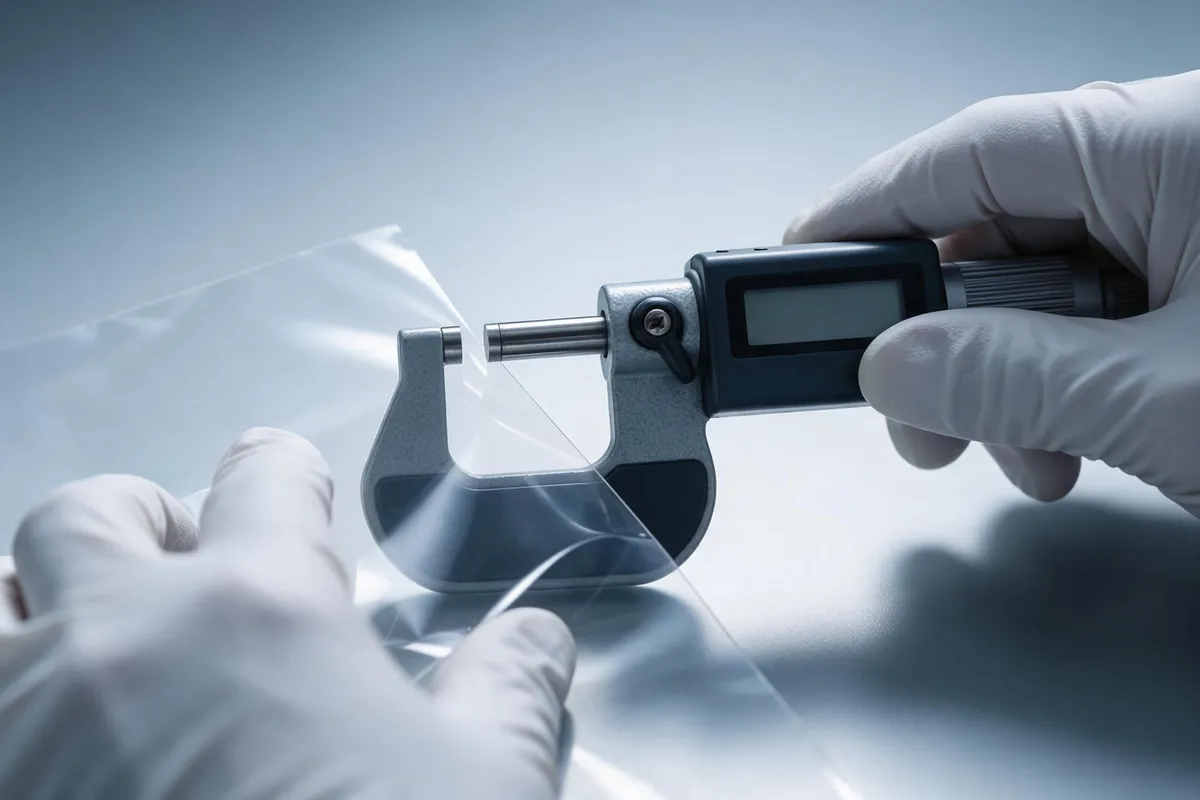
Control thickness across the web and along the roll against the agreed specification. A forming route does not imply a universal thickness below 0.1 mm; uniformity alone does not guarantee impact or aging performance. Request actual tolerances, optical measurements and qualification results.
Surface and optical quality
Die, roll surface, cooling and grade can influence the resulting surface. Do not infer microscopic smoothness, low haze or high gloss from “cast” alone. Measure the finished film in its intended finish; a matte or satin product is not judged by a gloss-model target.
Internal stress and dimensional stability
Both routes have thermal and mechanical histories. Actual grade, drawing, cooling and subsequent handling matter. Ask for shrinkage, curl and dimensional-stability data under stated conditions; do not assume all cast film has lower stress or that calendered film will lift at edges.
Where calendering may fit
Calendering is a process, not a poor-material category. Evaluate grade, equipment, output, yield and total cost for the proposed use, including liners or non-visible layers if relevant. Claims of lower cost, high output or inadequate PPF optics require actual evidence; none follows universally from the route name.
Choose process, finish and construction together, then qualify the actual film. Neither casting nor calendering alone accepts or rejects an application. Compare samples, thickness variation, optics and installation trials against agreed requirements.
How to verify the process from supplier records
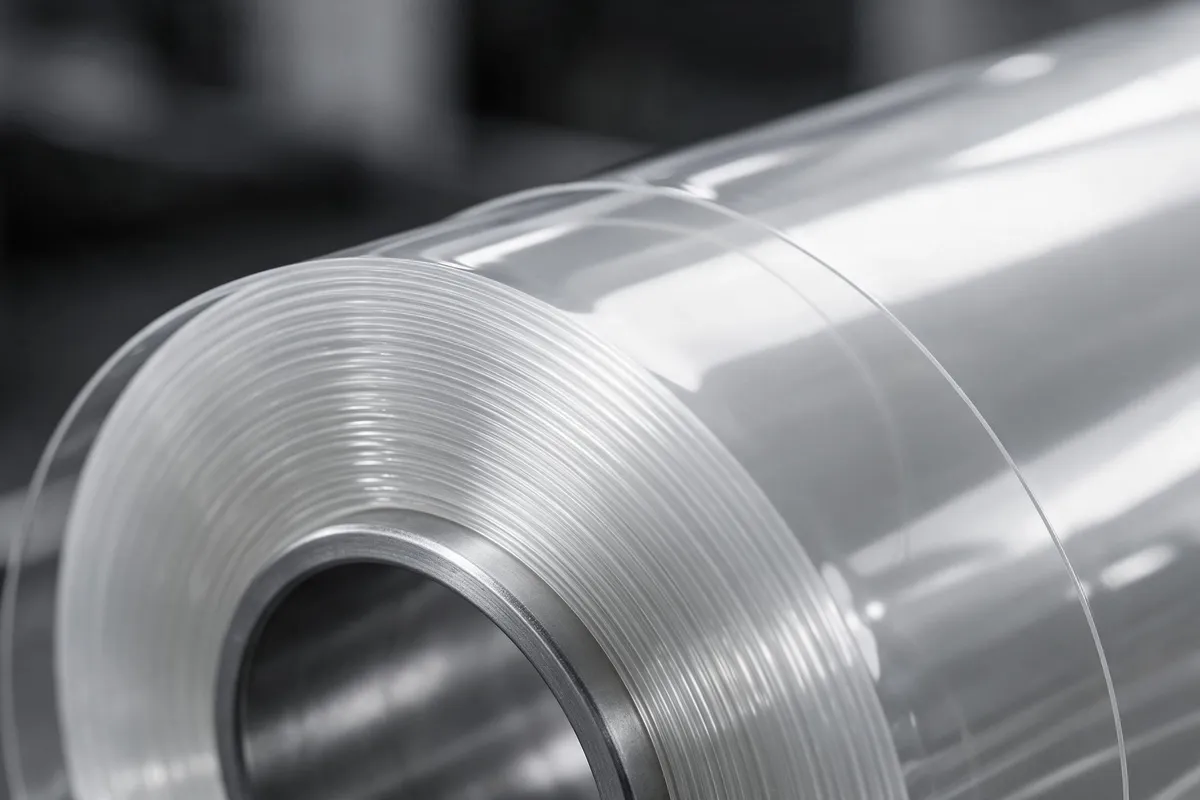
Tolerance, haze and gloss are useful quality data, not unique process fingerprints. Ask directly for the line configuration and traceable production records, then check the measurements. The table below lists questions, not a way to identify a route from numbers alone.
| Indicator | What to request | Interpretation limit |
|---|---|---|
| Thickness tolerance | μm or % across the web, with the sampling plan | A tight tolerance supports specification assessment, not proof of cast extrusion |
| Haze | Measured haze, specimen construction and method | For comparable specimens, lower haze may support clarity; it does not identify the route |
| Gloss at 60° | Gloss measured for the intended finish, not a universal maximum target | Gloss depends on the finished surface; it is not a unique process marker |
| Available thickness range | Actual nominal steps and tolerance for each construction | Available steps depend on grade and line; confirm rather than infer the process |
If the supplier cannot support a claimed process or tolerance, record it as unverified and request evidence. The same approach used in reading PPF specifications also applies here: compare values with their methods and conditions.
What forming can mean for coating and adhesive layers
Substrate consistency can affect coating and adhesive application, but the completed film must be assessed as a system. Do not infer uniform self-healing, stain resistance or gloss from substrate uniformity alone. Request coating-control records and relevant tests; no universal thin-spot/healing-time or thick-spot/haze rule is established here.
Review forming and coating together, including how each stage controls variation. A coating-line name does not resolve an unqualified substrate. Related construction differences are discussed in the TPU, TPH, PET and PVC substrate comparison.
Evaluate installation with representative film
Assess stretch, pressure response, curl, recovery and edge behavior on the actual construction. Process labels alone cannot predict tearing, air trapping or conformity to bumpers and mirrors. Use the approved method and record the sample, conditions and geometry; do not infer lower installation risk from “cast” alone.
Compare actual installation time and rework for qualified products, rather than assuming calendered film always needs more heat or edge work. Follow each product’s instructions; no generic heating recipe is given here. Labor and total cost vary with film, operator, geometry and environment.
Before bulk ordering, request representative samples from an identified batch. Trial a relevant complex shape, such as a mirror housing or bumper corner, using the product-approved workshop method and suitable test surface. Record time, rework and appearance. The result informs that trial, not a universal productivity guarantee.
What to ask about a forming line
Ask how forming, coating, converting and quality control are organized. If cleanliness is part of the purchase specification, confirm its classification basis and measurement conditions. Assess samples and reports; equipment lists and cleanroom labels alone do not guarantee finished-film performance.
During a factory review, ask about forming equipment, coating-area controls, slitting conditions and weathering resources. Verify answers through records and traceability. Four specific answers are useful leads, not proof by themselves that a company manufactures every offered film in-house.
Buyer process-verification checklist
| No. | Item | Evidence to request |
|---|---|---|
| 1 | Forming route | Actual cast-extrusion, blown-film or calendering configuration, equipment and records |
| 2 | Thickness tolerance | μm or % across the web and along the roll, with sampling conditions |
| 3 | Optical measurements | Finished-film haze and gloss at 60°, with specimen, finish and method |
| 4 | Coating environment | Agreed cleanliness requirement, classification basis, measurement and coating equipment |
| 5 | Slitting environment | Controls suitable for product and contamination risk; confirm whether the same classification is actually required |
| 6 | Weathering-test resources | Relevant xenon, QUV and damp-heat equipment, methods and reports; verify in-house or external scope |
For the broader supplier assessment, the PPF manufacturer selection guide places these checks in a wider sourcing framework.
Frequently asked questions
Is cast film always better than calendered film?
No universal ranking follows from the forming name. Select a suitable grade and construction, then compare measured tolerance, optics, durability and installation results against the intended use. Neither route is automatically accepted or rejected for PPF.
How can I verify whether PPF is cast or calendered?
Request equipment configuration, process records and traceability. Thickness tolerance, haze and gloss help assess quality but cannot uniquely identify the route. Record unsupported process claims as unverified rather than inferring the answer from appearance alone.
Can forming affect self-healing performance?
It can influence the substrate presented to the coating process, but does not independently establish self-healing or stain resistance. Verify the complete coating system, thickness control and applicable product tests; substrate uniformity alone is not a performance guarantee.
Does cast extrusion automatically produce clearer film?
No. Surface formation and cooling are relevant, but actual resin, formulation, process control and finish matter. Compare haze and gloss measured on the intended finished construction; do not infer transparency, low scatter or a “wet-paint” appearance from the route name alone.
Which cleanliness requirement should be specified?
Set dust and particle controls for coating and slitting based on the product and the process. Record the conditions and inspection results for each area.
A practical process-selection rule
Verify the actual forming route and the finished film before negotiating supply. Cast extrusion, blown film and calendering are process descriptions, not automatic optical, stress, cost or service-life rankings. Choose against the required construction, finish and documented results.
Suggested next step
For CHISI’s manufacturing context, review the R&D and factory page , then compare the actual model and finish specifications in Type B PPF and Type R PPF . For a specific project, contact the team to request the target product’s thickness tolerance, optical data and applicable test conditions.
References
- CHISI manufacturing documents: forming, coating, cleanliness, slitting and testing references; confirm the applicable equipment, version and product scope.
- CMPE PPF category: general industry summaries, not route-wide comparative test evidence for every TPU film.