
Short answer: Washing alone does not establish that paint is ready for PPF. Assess remaining deposits, previous protection products, paint condition and the film’s preparation requirements. Chemical cleaning, mechanical decontamination and a final surface clean are source planning categories, not mandatory steps or one fixed sequence for every finish.
Defects or contamination under film may affect appearance and adhesion, but not every mark becomes permanent or predicts failure. Inspect and document the surface before installation. Preparation is one part of performance, alongside the film, adhesive, application and exposure; it cannot by itself guarantee the whole service life.
This guide covers contamination assessment, compatible preparation methods, source waiting-time examples and pre-install inspection. Follow the actual paint, cleaner and film instructions rather than treating the article as a universal chemical or polishing procedure.
On this page
Clean appearance and installation readiness
A wash may remove loose dirt while leaving other deposits or protection products. Its effectiveness depends on the actual cleaning system and contamination. Inspect what remains rather than assuming washing removes everything or nothing from a particular contaminant class.
Ferrous contamination. Brake or rail particles can remain on paint and may contribute to staining or surface defects. Confirm their identity and the paint compatibility of any iron-removal product. Roughness or orange dots alone do not prove one cause.
Tar and asphalt deposits. A tar-like deposit may affect local contact and appearance. Identify it and use a compatible removal method; do not assume every dark mark is tar or that it will remain for the film’s entire life.
Water spots and mineral deposits. Distinguish a surface deposit from etching or another paint defect. Their treatment differs. Do not assume every water mark continues reacting beneath film or becomes permanently uncorrectable once covered.
Previous wax or synthetic paint protection. A remaining protection layer can affect adhesive contact. Confirm its identity and the specified removal requirements; a visible bond or an elapsed number of weeks does not establish long-term compatibility or the cause of later lift.
Silicone-containing detailing products. Residues from some detailing products can change wetting or contact. Their effect and removal depend on the actual formulation and surface. Silicone is not a diagnosis for every bubble or edge lift, and alcohol is not a guaranteed universal remover.
For the interface background, see PPF adhesive science; for the following installation process, see PPF installation guidance.
Three preparation categories
Chemical cleaning, mechanical decontamination and final cleaning address different tasks. Select only the steps and sequence permitted for the actual paint, contaminants and film. They do not all have to be used, and a fixed sequence does not establish compatibility or readiness.
| Contaminant or condition | Compatible method to assess | Possible effect if unresolved |
|---|---|---|
| Ferrous particles | Specified iron remover and rinse process, if permitted | Possible staining, surface defects or contact changes |
| Tar or asphalt deposits | Paint-compatible product selected for the identified deposit | Possible visible mark or poor local contact |
| Water marks | Identify deposit versus paint damage before selecting treatment | A remaining deposit or an existing paint defect may be visible |
| Wax or synthetic protection residue | Use the paint and film’s approved removal procedure | Possible adhesion change; no fixed delayed-failure period |
| Detailing-product residues | Identify the product and confirm a compatible preparation cleaner | Possible wetting or contact issue; not a unique diagnosis |
This table identifies questions, not a chemical recipe. Confirm the exact cleaner, concentration, contact time, rinse method and paint/film compatibility. A product called mild, acid-free or an adhesive remover is not automatically suitable for every finish.
Assessing chemical cleaning
Use chemical decontamination only where appropriate for the identified deposit and paint. Follow the product’s surface condition, temperature, contact, rinse and safety instructions. A cool panel or working out of sunlight does not by itself make an incompatible chemical safe.
Tar treatment may require a different compatible product, but do not assume it must always be stronger or applied by one cloth method. Do not mix products or carry reactive residues into another step. Follow the specified rinsing and surface-preparation instructions rather than a universal chemical sequence.
Assessing mechanical decontamination
Clay media can remove some bonded surface contamination, but they can also mark paint or alter texture. Confirm whether the paint permits the method, with the specified grade, lubrication and pressure. Chemical cleaning does not establish that clay treatment is automatically needed afterward.
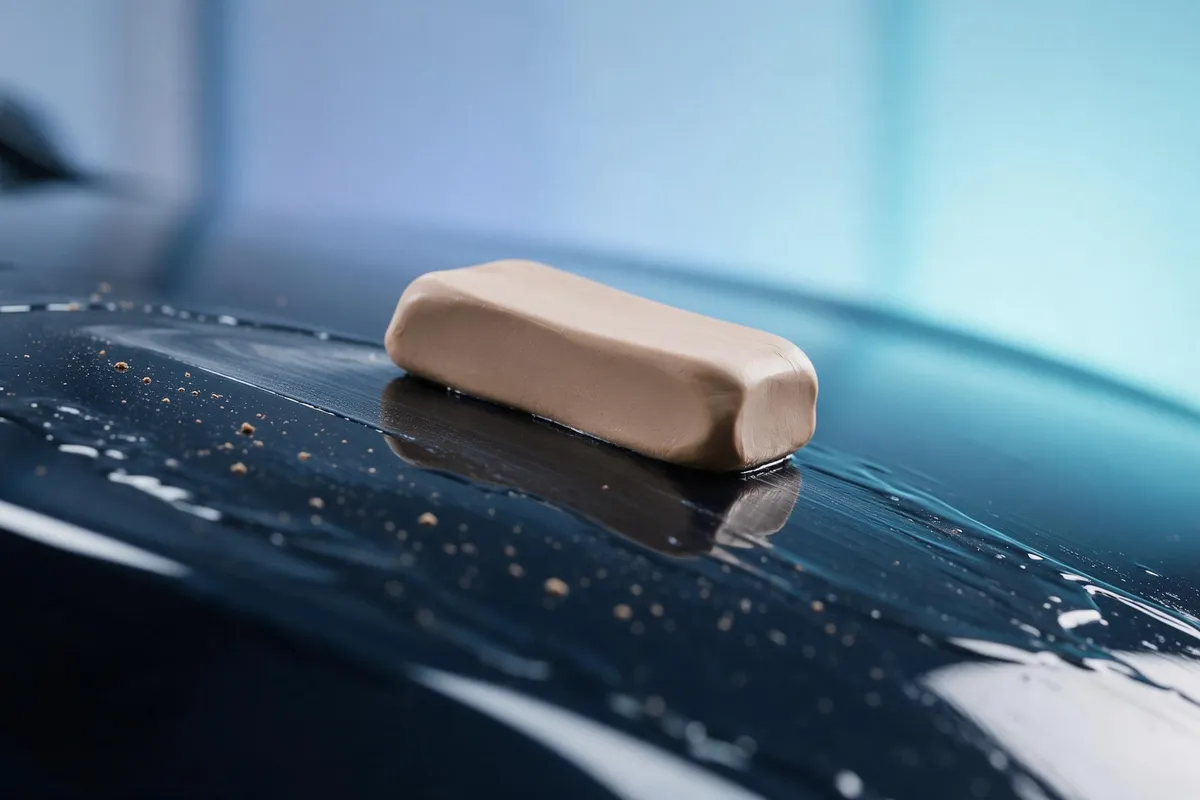
Follow the tool and paint instructions and inspect the media for trapped particles. Smoothness alone does not establish chemical cleanliness or a film-ready surface. If a rough area remains, identify the cause rather than automatically polishing or repeatedly claying it.
Persistent roughness may be contamination, texture or a coating defect; it does not prove damage below the surface. Have the paint assessed before correction. Polishing is not suitable for every finish and does not create one universal waiting period before PPF.
Final surface cleaning
The final clean should address residues from the actual preceding process, including cleaner, lubricant, polishing products or handling. Verify the surface using the paint and film requirements; the name of a degreasing step is not proof that every contaminant has been removed.
Use the specified final cleaner and application method, including permitted concentration, contact and residue removal. Do not prescribe IPA or a two-cloth method for every finish. A tacky or slippery feel alone cannot identify oil, prove full degreasing or predict a failure weeks later.
Readiness after polishing
Polishing products may leave residues, and the cleaning or paint process may have its own readiness conditions. Not every polish requires outgassing for a fixed period. Confirm the paint, preparation-product and film instructions and assess the surface rather than assigning a universal wait.
| Source preparation example | Evidence to request |
|---|---|
| Light polishing, described as low-oil | Confirm the actual residue-removal and product-readiness criteria |
| Compounding and polishing | Odor and visible residue are observations, not a complete acceptance test |
| New single-stage or refinish paint | Confirm the coating system, process and suitability for film application |
Elapsed time, odor, gloss or surface feel alone cannot establish readiness. Follow the specified inspection and environmental conditions; do not improvise heating or ventilation as a way to shorten an undocumented paint or cleaner waiting period.
Paint conditions requiring confirmation
A new, repaired or textured finish may need a different preparation and approval process. Do not treat factory paint, refinish and matte paint as uniform categories; establish the exact coating and its instructions before proceeding.
New refinish with unconfirmed readiness. Confirm the paint system and actual process with its manufacturer or repairer. A calendar interval or stable appearance does not alone establish complete cure, adhesion or suitability for PPF.
Single-component or aerosol repair products. These labels do not define one curing chemistry or one film-compatibility result. Identify the exact product, coating build and curing instructions. Obtain the paint supplier’s assessment rather than automatically accepting, rejecting or prescribing a hidden-corner test as proof for the whole panel.
Matte and satin paint. Preparation, polishing or film can change the appearance of some textured finishes. Confirm the exact paint and an approved film/preparation system. Do not use a standard gloss-paint claying or polishing routine without evidence that it is suitable.
Readiness includes coating condition, compatibility and the specified preparation—not hardness or outgassing alone. For subsequent care, see PPF care and maintenance; those care instructions do not replace the paint maker’s pre-install requirements.
Pre-install inspection
Agree and record the acceptance criteria before cutting or applying film. A checklist helps organize evidence but does not prove every defect has been prevented or that every substrate is suitable.
| Inspection item | Condition to verify | Assessment or action if unmet |
|---|---|---|
| Surface moisture | Meet the specified preparation-stage condition; check condensation | Confirm drying and environmental conditions before proceeding |
| Temperature | Use the paint supplier’s readiness criteria for the actual coating system. Record the cure history and check surface condition before installation. | Use the documented paint, cleaner and film conditions |
| Lighting | Suitable lighting for the finish and inspection task | Inspect relevant viewing angles; lighting alone is not a complete surface test |
| Final-clean verification | Meet the documented residue and compatibility criteria | Investigate unresolved residue; do not simply repeat IPA on every surface |
Record the preparation products, methods, conditions and inspection result for each panel. This supports traceability and later investigation, but does not by itself prove long-term adhesion, exclude material defects or establish warranty responsibility.
Frequently asked questions
Is washing enough before PPF?
Not as proof of readiness. Inspect the actual deposits, previous coatings and paint condition, then use the preparation approved for the film and finish. A three-stage example is not mandatory for every car, and contamination does not automatically predict permanent damage.
Can clay replace chemical cleaning?
There is no universal substitution rule. Identify the contamination and check which chemical or mechanical method the paint permits. Neither clay alone nor a fixed chemical-first sequence guarantees removal, compatibility or freedom from marring.
How can final-clean readiness be checked?
Use the documented paint and film criteria, with the specified cleaner and residue inspection. Surface feel, smell or one clean cloth are observations, not complete proof. If unexplained residue remains, identify it and confirm the next method instead of repeatedly applying alcohol.
How long after polishing can film be applied?
Confirm the polish, cleaner, paint and film requirements. Inspect for the specified readiness conditions rather than using elapsed time or an odor check as the only acceptance test.
Can film be applied to a freshly repainted panel?
Confirm the exact paint system and application process with the paint manufacturer or repairer before proceeding. Do not assume either immediate suitability or automatic rejection from the word repaint alone.
Can clay treatment change matte paint?
It may change texture or appearance, depending on the paint and method. Confirm an approved preparation and film system for the exact finish. Do not treat lubrication, light pressure or a matte label as proof that a standard clay or polishing process is suitable.
Why can silicone-containing residues affect bonding?
Some residues change surface wetting or adhesive contact. The effect depends on the product, amount and substrate; they do not prove the cause of every delayed bubble or lift. Identify the residue and use a verified compatible cleaner rather than assuming IPA removes every silicone formulation.
What temperature should the preparation area be?
Use the documented conditions for the paint, preparation products and film. Surface temperature, moisture and ventilation need their own specified controls; no room-temperature label proves the process is safe.
Documenting preparation before installation
Define the surface condition, compatible preparation, any product-specific waiting requirement and inspection record before installation. This supports an assessable process, not a guarantee against every defect or a basis to exclude material responsibility automatically.
For the interface background, see PPF adhesive science; for the following installation, PPF installation guidance; and for later care, PPF care and maintenance. To discuss preparation products and film for a specific paint system, contact our team.