

Quick guide: Assess migration for the actual formulation and contacting materials. TPU can obtain flexibility from its polymer structure without the added plasticizer used in many flexible PVC formulations, but a material label does not prove that a finished laminate has no mobile ingredients. Define the contact, exposure, measurements and acceptance criteria; stiffness, staining or a peel change alone does not identify plasticizer migration.
Migration can be one contributor to changes during storage or service. A film that becomes brittle, sticky or stained needs investigation of material, contact partners, aging and installation conditions. Neither the symptom nor the elapsed number of months establishes the transferred substance or its source.
This guide separates formulation questions, possible effects, exposure conditions and purchasing checks. Agree a method for the selected construction and use before comparing results.
On this page
- 1. Understanding migration
- 2. Formulation differences between PVC and TPU
- 3. Possible material and bond changes
- 4. Exposure and contact conditions
- 5. Reviewing the contacting materials
- 6. Measuring mechanical changes
- 7. Specifying migration requirements
- 8. Receiving checks and comparison
- 9. FAQ
- 10. Discuss the application
Understanding migration
Plasticizers are ingredients used to modify flexibility and other properties in some polymer formulations. Their identity, molecular size, compatibility and incorporation vary. An ingredient that is not chemically bound may move under suitable conditions, but not every plasticizer is a small molecule with the same mobility or loss mechanism.
Distinguish transfer between contacting layers from evaporation, extraction and chemical degradation. Loss or uptake of an ingredient may alter properties, but the direction and extent depend on the materials and exposure. A short test can be useful when validated for its purpose; duration alone does not establish or exclude long-term compatibility.
Formulation differences between PVC and TPU
Many flexible PVC formulations use added plasticizer, but content and mobility depend on the grade and application. Do not identify an unknown seal as plasticized PVC, or assign a migration rate, from softness alone.
TPU can gain flexibility through its soft and hard polymer segments without requiring an external plasticizer. That principle does not identify the polyol, additives or adhesive in every CHISI film. Use the selected series’ confirmed construction rather than declaring all products PCL-based or additive-free. The related hydrolysis discussion concerns a different degradation mechanism; it does not prove zero migration or extend Type B’s confirmed hydrolysis statement to all TPU or PCL materials.
Compare the actual formulations and laminate layers, not only the labels TPU and PVC. A formulation that needs no added plasticizer can still contain other mobile ingredients or interact with a contacting material. A migration requirement needs evidence for the complete intended combination, not a generic low-risk ranking.
Possible material and bond changes
The following are possible effects to investigate, not a diagnostic sequence or proof that migration caused a particular complaint. Several mechanisms can occur together. Compare the material condition, contact history and relevant measurements before identifying the substance or assigning responsibility.
Loss of a softening ingredient can contribute to stiffening or lower elongation in some formulations. Cracks, poor bending or removal tears can also have other causes. Measure changes against a suitable control; do not diagnose additive loss from an edge crack or cold bend alone.
Ingredients entering a pressure-sensitive adhesive may change its cohesive or interfacial behavior. A peel change or edge lift is not specific to migration, and the adhesive is not necessarily the first affected layer. Review adhesive identity, substrate, conditioning and exposure before drawing a conclusion.
Transfer between contacting materials can be associated with staining, softening or surface changes, depending on the combination. Do not assume that every fogged or stained area is plasticizer migration, or that a neighboring part rather than the film is responsible. Investigation must keep both materials and other degradation mechanisms in scope.

Exposure and contact conditions
Review temperature, time, contacting area, material compatibility and the type of transferred substance. These factors can influence transfer, but they do not define one universal rate or rank of severity. Migration, volatility and chemical aging need methods that distinguish their contributions.
Temperature is an important test condition, but its effect depends on the system. Use the selected model’s applicable conditions; a short heat test is not a continuous-service or migration qualification.
Light exposure can age polymers or coatings and may alter transfer behavior. It does not establish that every UV-exposed material develops migration pathways or that combined heat and light is always the worst condition. Select a relevant exposure and separate chemical aging from substance transfer.
Pressure and contact geometry can change the real contacting area and the conditions for transfer. Record the load, duration, surface and layer arrangement in a test. Do not assign every loaded roll or contacting seal a faster migration rate than a separated control without a defined comparison.
Identify the actual adjacent material before assessing a plasticized-PVC contact. A barrier or alternative material may change transfer, adhesion and fit; its effectiveness must be evaluated for the combination. Softness or proximity alone does not establish a large plasticizer reservoir or a guaranteed benefit from separation.
Reviewing the contacting materials
Use this table as a list of formulation and compatibility questions, not as a fixed migration-risk classification. Confirm the grade and each laminate layer. No row supplies CHISI ingredient disclosure, a laboratory migration result or a guarantee for all contacting parts.
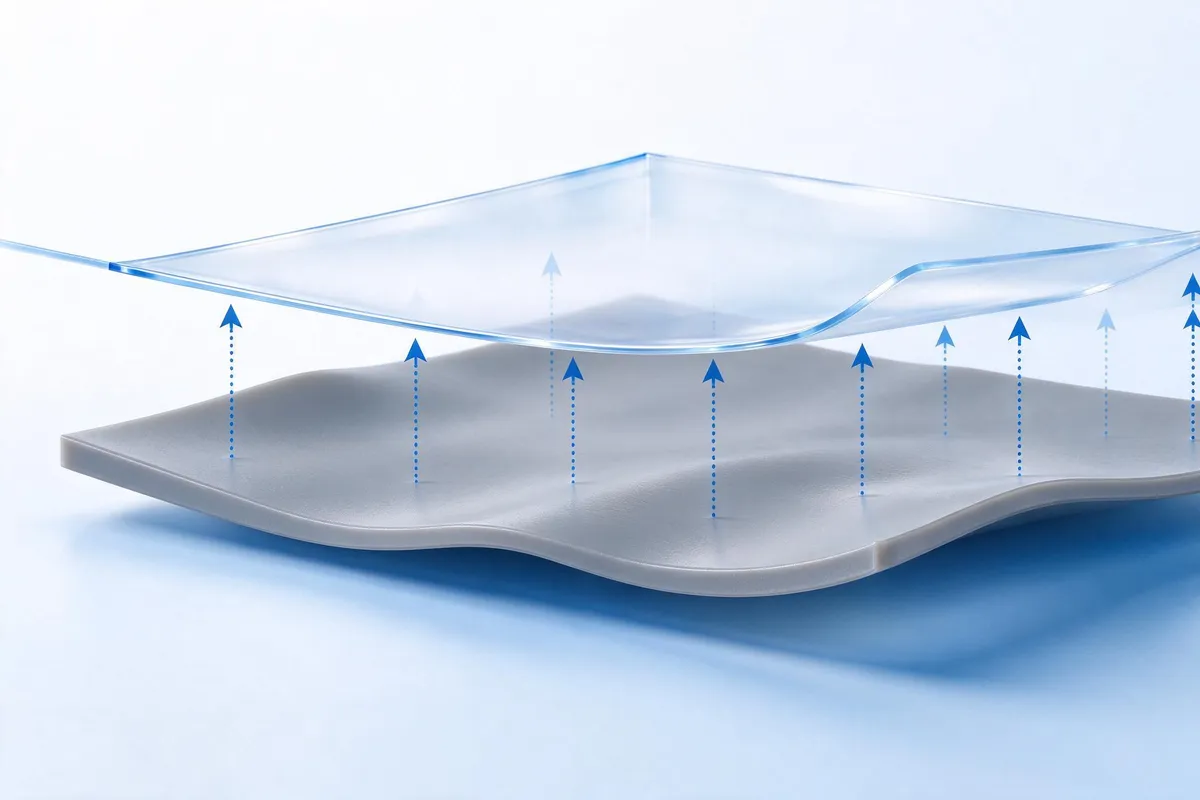
| Material or layer to identify | Formulation question | Contact-compatibility question |
|---|---|---|
| Flexible PVC trim or seal, if confirmed | Confirm plasticizer identity and content where applicable | Assess the actual formulation and contact conditions |
| Plasticized PVC edge guard | Do not infer additive loading from softness alone | Test the intended interface and exposure |
| TPU base film of the selected grade | Flexibility need not require an external plasticizer | Confirm the complete laminate, not only the base polymer |
| Pressure-sensitive adhesive in a TPU-film laminate | Confirm adhesive identity and relevant mobile ingredients | Do not assume a TPU-based adhesive or a fixed risk class |
| ABS or PC molding of the selected grade | A resin name does not disclose all additives or surface treatments | Check uptake, surface effects and the actual contacting pair |
Measuring mechanical changes
Mechanical measurements can characterize changes after exposure, but they do not by themselves identify plasticizer loss. Use controls and a suitable analytical approach when the cause matters. Initial properties, conditioning and other aging mechanisms must remain part of the comparison.
Elongation-at-break retention compares an aged result with a defined unaged reference. State the calculation, specimen, test temperature and rate, as well as the absolute results. Retention helps comparison but does not erase formulation differences or prove a specific stiffening mechanism.
A low-temperature bend test evaluates behavior under a defined temperature, bend geometry and procedure. Cracking can indicate a mechanical change but is not specific to migration. Compare conditioned controls rather than treating one cold fold as proof of additive loss or suitability for every winter condition.
Impact testing can add information when appropriate for the specimen and application. Report the method and relevant energy or force result without mixing different endpoints. A change after aging does not by itself identify stiffening, migration or an installed stone-impact performance level.
| Measurement | Information obtained | Conditions to report |
|---|---|---|
| Elongation-at-break retention | Change relative to a defined unaged reference | Report percentage, absolute values, temperature, rate and calculation |
| Low-temperature bend | Behavior under specified bending conditions | Report temperature, geometry, procedure and pass/fail criterion |
| Impact or dart-drop test | Method-specific failure response | Report method, specimen, endpoint and comparable controls |
Specifying migration requirements
Define the relevant substances, contacting materials, exposure and measurements with the supplier. The table contains purchasing questions, not approved CHISI contractual terms or universal safe limits. A “non-migrating” claim needs an agreed meaning and detection or acceptance criteria rather than an unqualified zero-transfer promise.
| Specification topic | Question to agree | Evidence to define |
|---|---|---|
| Relevant mobile ingredients | Request a suitable material statement for the intended layers | Agree disclosure scope; do not assume a full proprietary recipe is supplied |
| Retention after defined exposure | Agree an application-relevant criterion, if needed | Compare defined specimens before and after documented conditioning |
| Contact-transfer assessment | Define acceptable surface and mechanical changes for both partners | Record material pair, temperature, time, contact load and measurements |
| Adhesive-bond behavior | Agree the method, substrate and acceptance range | Record the film and paint system, preparation, installation conditions and location of the issue. Use the product’s approved procedure before deciding on rework. |
Receiving checks and comparison
Agree a receiving plan linked to qualification and the actual material pair. A contact exposure may be one screening approach, but it is not automatically the cheapest, fastest or sufficient proof of long-term behavior. Define handling, controls, duration, temperature, load and measured endpoints before testing; visual inspection alone does not identify the migrating substance.
Compare retention, adhesion and other agreed endpoints under equivalent conditions, and investigate results outside the agreed criteria. The adhesion discussion reviews peel-test conditions. A peel change alone is not proof of migration.
Include the adjacent trim or seal in the review when contact is intended. Request relevant grade and compatibility information within an agreed disclosure scope. Neither an apparently clean film nor a soft neighboring part determines the source of a later stain. The related hardness and modulus discussion provides mechanical context, not a migration-rate calculation. Hardness, modulus and contact pressure are not interchangeable. Evaluate the intended system instead of treating one film measurement as complete contact-compatibility evidence.
Frequently asked questions
Does a TPU label prove that PPF contains no plasticizer?
No. TPU can obtain flexibility without an external plasticizer, but the actual grade, additives, coating and adhesive need their own information. Do not extend a base-resin description to every finished laminate or assume zero migration from the TPU label.
Which changes may justify a migration investigation?
Stiffness, elongation, peel behavior, surface appearance or a contacting part may change. There is no universal first symptom. Compare controls and relevant analytical evidence; edge lift, cracking or fogging alone does not identify the substance, direction of transfer or responsibility.
Which exposure conditions should be assessed?
Use temperature, time, light, contact geometry and load appropriate to the actual materials and application. Their effects are system-specific. A general claim that parked-car heat, UV or pressure is always the worst case is not a qualification method or a universal safe limit.
Can a migration-related change be repaired?
Identify the mechanism and affected materials first. Cleaning a stain does not restore a changed formulation or prove that transfer has stopped. This guide gives no universal reversible or irreversible verdict and no field solvent or reheating remedy; agree corrective work with the relevant product suppliers.
How can migration risk be screened?
Define a relevant contact exposure with controls, followed by agreed surface, mechanical and analytical checks. A heated contact pair is not automatically the quickest or a complete qualification. The chosen method must distinguish the property change from its cause and state what the result can support.
Should the adjacent trim or seal be checked too?
Yes, where contact is part of the intended use. Identify both grades and the contact conditions, and request relevant compatibility information. Do not infer a plasticizer type or blame the neighboring part from softness, staining or a material name alone.
Discuss the application
Specify the selected construction, contacting materials and intended exposure before agreeing migration criteria. Reference data and a successful sample test do not automatically establish every shipment’s performance or a service-life guarantee. Keep traceable results and investigate meaningful changes against the agreed method.
Our R&D and factory overview provides background on our capabilities; confirm which evidence or development work is available for your selected application. Default A4 samples are free worldwide, excluding logistics charges; request a quote for other sizes. To discuss the intended material pair, contact our team with the actual trim and seal identities and intended conditions.