
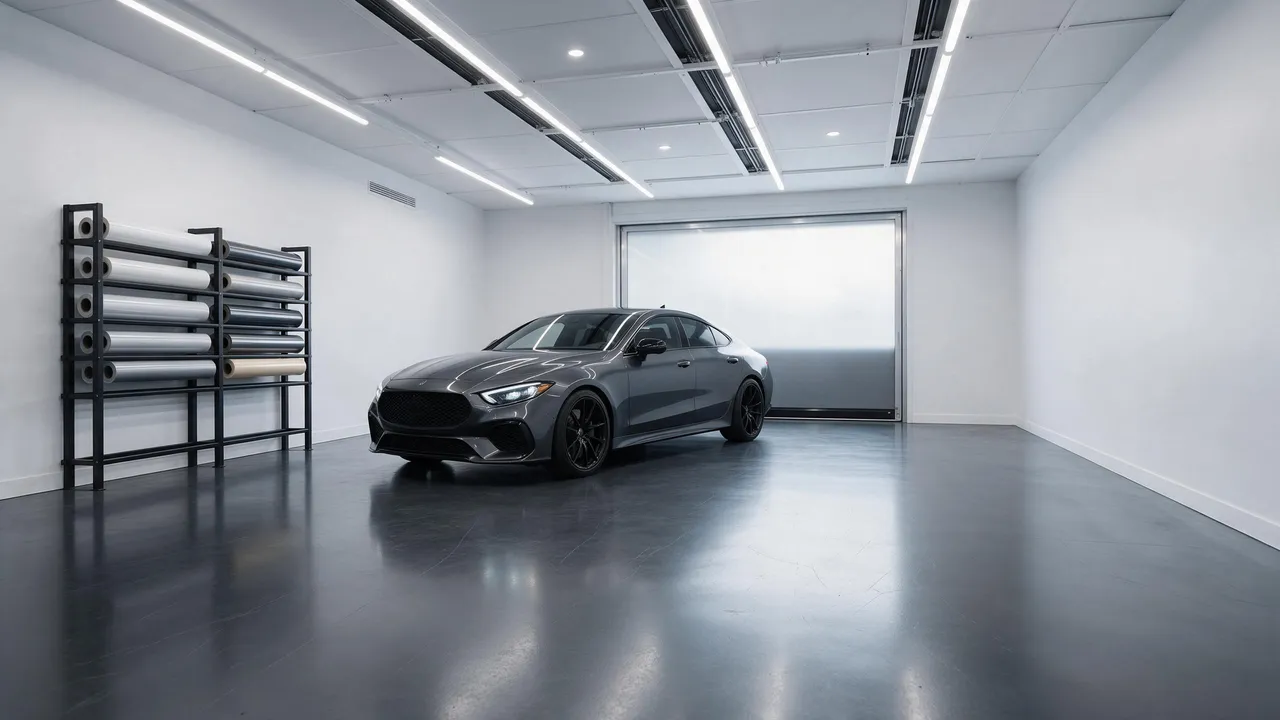
Short answer: A PPF installation business needs four budget blocks: a dust-controlled bay, cutting capability, film inventory and installer skill. Calculate film use, labor time and selling price per vehicle before ordering stock.
PPF installation sells a service as well as a material. Film is easy to compare by brand and price, but a launch budget also needs space, lighting, blades, training, rework and cash tied up in unsuitable roll widths.
This guide helps distributors and studios planning a PPF service, and brand owners assessing the investment their dealers may need. Figures and operating scenarios are source planning references, not returns or performance guarantees.
On this page
Choose the business model before the equipment
Equipment follows the operating model. These four source examples show how the initial purchase and main constraint can change.
| Model | What you sell | First purchase | Main constraint |
|---|---|---|---|
| Mobile installer | Partial-front kits, track-use protection, dealer-lot work | Pre-cut kits, hand tools, portable lights | Outdoor dust control is difficult; assess suitability for limited coverage |
| Bay in an existing shop | PPF added to detailing, tint or bodywork | One bay, plotter, starter stock | Shared space and scheduling |
| Dedicated PPF studio | Full-body installation, color PPF, premium vehicles | Two bays, climate control, broader inventory | Monthly fixed costs and consistent demand |
| Distribution and training | Film, tools and installer training for a dealer network; verify any credential scope | Stock depth, samples, training space | Working capital and technical support |
A dedicated studio with an unproven sales pipeline exposes the operator to fixed rent without matching work. Test demand first.
Plan the installation bay
Dust trapped under clear film can remain visible and may require lifting or replacing the affected section. Plan cleanliness, inspection and rework access into the facility budget.
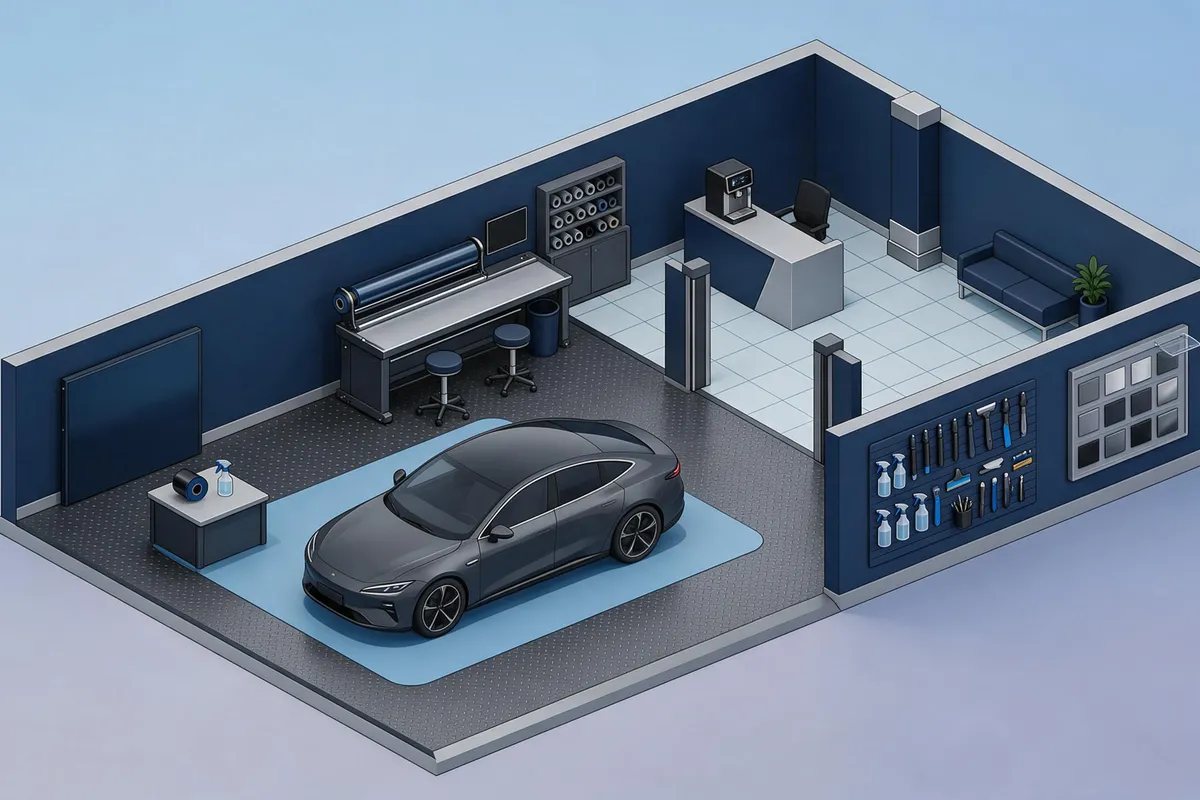
Working-space example. Check the actual vehicle, door opening and local premises requirements; these are layout references, not a universal minimum standard.
Use diffuse overhead lighting and a movable inspection light at panel level. Check visibility on paintwork and film from the positions where installers actually work.
Keep the installation bay clean and monitor air, temperature and humidity at panel level. CHISI film preparation and installation use 15–25°C and 45–50% relative humidity.
Water and flooring. Where the exact film permits wet installation, plan the specified solution, sprayer and runoff management. Confirm drainage, material compatibility and local site requirements separately.
Equipment and historical reference prices
They are historical planning inputs, not current CHISI offers. Obtain the currency, specification, MOQ, trade terms, validity, freight, duties and local charges for an actual quotation.
| Item | Role in the plan | Can it be deferred? |
|---|---|---|
| Cutting software | Vehicle templates, nesting and margin control; verify catalog and license scope | Possible with purchased pre-cut kits |
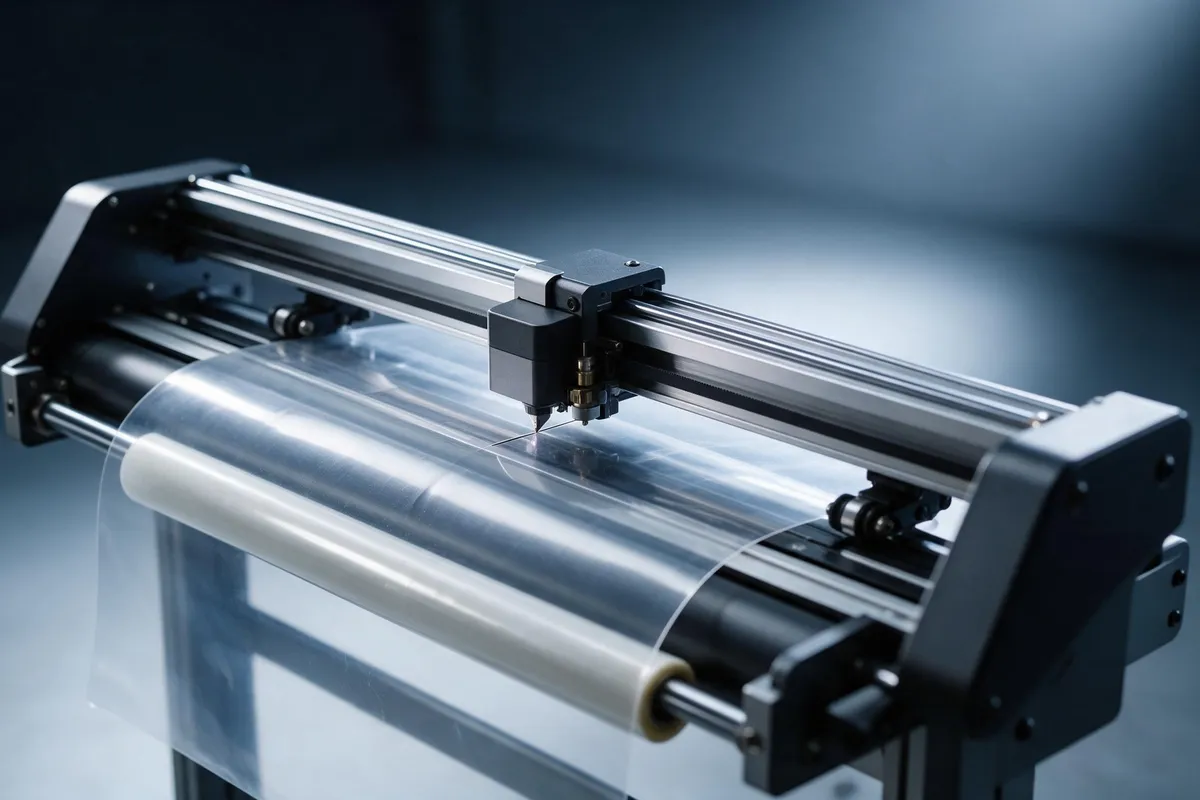
| Entry vertical plotter (CS1600) | Build the estimate from current product quotations, equipment and labor costs, material waste and the costs for your shipping route. | Needed if cutting in-house |
| Servo plotter (CS7000 / CS8500) | Source describes higher accuracy/throughput and touchscreen/CCD on CS8500; confirm actual equipment data | May be deferred at low volume |
| Flatbed cutter (RS1600 / RS1600D) | Build the estimate from current product quotations, equipment and labor costs, material waste and the costs for your shipping route. | Assess against production cutting volume |
| Hand tools | Squeegees, blades, heat gun, sprayers, edge tools and gauges; use according to product instructions | Core installation tools |
| Lighting and inspection | Raking light and color-appropriate inspection lighting | Include in the plan |
| Air filtration / dehumidifier | Control dust and humidity; measure the actual effect on rework | Include in the plan |
| Sample and demonstration kit | Film swatches, impact demonstration device, gloss meter and color fan; demonstration is not certification | Include if needed for the sales process |
Software and contamination control deserve a separate cost review. Nesting influences yield, while filtration may reduce avoidable rework.
Plotter and rolls, or pre-cut kits?
Compare the working capital, job mix and cutting capability before choosing. The lowest roll price is not necessarily the lowest total operating cost.
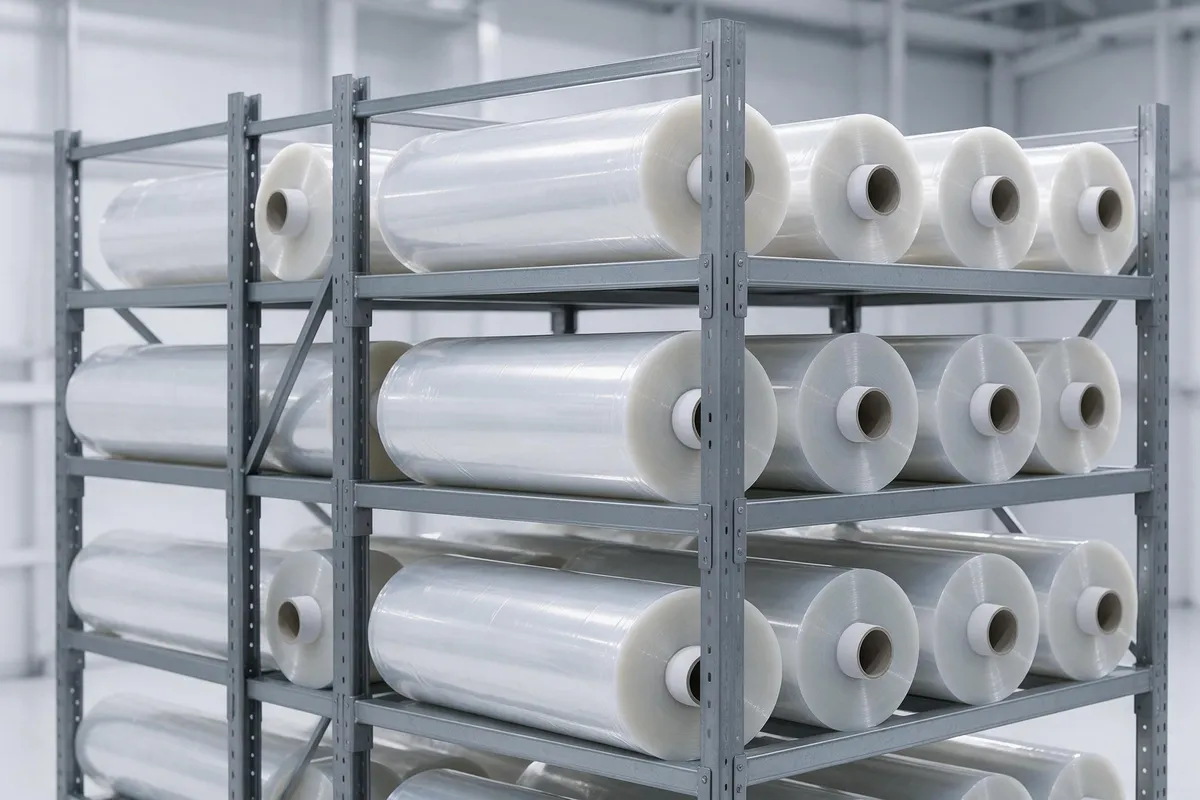
Bulk-roll model. Hand or plotter cutting can offer flexibility, subject to film and equipment limits. Allow for tied-up cash, cutting waste and product-specific storage instructions. Two years in storage is an aging-risk example, not a universal shelf-life limit.
Pre-cut kit model. Vehicle-specific kits shift cutting and nesting work to the supplier, usually with a separate price effect. They can reduce stock committed to each job, but depend on actual kit availability, dispatch arrangements and catalog coverage. Compare a current quote rather than assuming a universal premium.
| Factor | Rolls and plotter | Pre-cut kits |
|---|---|---|
| Cost per m² | Potentially lower before waste and equipment costs | Build the estimate from current product quotations, equipment and labor costs, material waste and the costs for your shipping route. |
| Cash committed | Higher per roll in this example | Lower per job in this example |
| Film waste | Depends on nesting and cutting practice | Included in the supplier's kit costing |
| Coverage flexibility | Within roll, equipment and product limits | Within the actual kit catalog |
| Storage-aging risk | Assess slow-moving rolls and storage conditions | Less stock exposure, not zero aging risk |
A hybrid may suit a new shop: two or three rolls in proven widths, a plotter where justified, and pre-cut kits for occasional vehicles. Keep a premium material grade as a sample before committing to stock. These are planning choices, not a prescribed inventory or guaranteed saving. See PPF wholesale pricing and landed cost.
Three startup budget examples
These source planning ranges are not quotations. They assume rented premises, imported film and an owner doing installation initially.
| Cost block | Lean: shared bay | Standard: one dedicated bay | Flagship: two bays and showroom |
|---|---|---|---|
| Bay preparation, lighting and filtration | $2,000–4,000 | $8,000–18,000 | $25,000–50,000 |
| Cutting equipment and software | Build the estimate from current product quotations, equipment and labor costs, material waste and the costs for your shipping route. | $3,000–5,000 | Build the estimate from current product quotations, equipment and labor costs, material waste and the costs for your shipping route. |
| Hand tools and test kit | $400–800 | $1,200–2,500 | $4,000–8,000 |
| Opening film inventory | $3,000–6,000 | $10,000–20,000 | $30,000–60,000 |
| Training and any separately verified qualification | $500–1,500 | $2,000–5,000 | $6,000–15,000 |
| Branding, samples and launch marketing | $500–1,500 | $2,000–5,000 | $8,000–20,000 |
| Indicative source total, not a quote | ≈ $8,000–14,000 | ≈ $26,000–55,000 | ≈ $80,000–170,000 |
Check the cost of cleanliness and training rather than assuming they can be deferred. Hold operating cash outside equipment purchases and test the budget against delays and rework. No payback period follows from the table alone.
Per-vehicle economics
Build a local model for each job type. The following material, labor, rework and retail multipliers are source scenarios, not measured CHISI productivity, current prices or expected margins. Check whether hours mean elapsed time or total person-hours before costing a two-installer team.
| Line | Partial front | Full body |
|---|---|---|
| Film consumed | 3–5 m² | 15–20 m² |
| Labor hours (two installers; basis to confirm) | 4–8 h | 24–36 h |
| Build the estimate from current product quotations, equipment and labor costs, material waste and the costs for your shipping route. | Build the estimate from current product quotations, equipment and labor costs, material waste and the costs for your shipping route. | A major variable cost in this scenario |
| Source rework allowance | 5–10% of jobs (planning example) | 10–20% while learning (planning example) |
| Retail price | Build the estimate from current product quotations, equipment and labor costs, material waste and the costs for your shipping route. | Build the estimate from current product quotations, equipment and labor costs, material waste and the costs for your shipping route. |
Do not scale a partial-front price by area alone. Bumpers, mirrors, edges and other complex geometry can add labor and waste.
Before launch, record a supervised trial installation, including time, defects and rework.
Hiring and installer skill
The following three skill groups are an internal planning framework, not an industry qualification. Assess demonstrated work rather than assuming everyone progresses in weeks, months or years at the same rate.
- Level 1 — pre-cut kits. Partial kits, permitted wet installation, specified solution and squeegee technique.
- Level 2 — panels and bumpers. Complex curves, consistent edge finishing and diagnosis of lifting or contamination, within product instructions.
- Level 3 — full-body and color PPF. Coverage planning, seams, film direction, coaching and knowing when a job is unsuitable.
Assess workload, supervision and actual capability locally. A demonstration on a suitable practice panel can support hiring; a portfolio alone does not establish consistent installation quality.
Six launch risks
- Stocking before validating demand. For example, three unpopular color rolls can tie up cash needed for essential equipment.
- Under-budgeting the installation space. It is a scenario, not a measured failure rate or universal time multiplier.
- Competing on price alone. A low selling price does not establish poor skill, but it can leave little allowance for training, overhead and rework. Compare the full service scope.
- Ignoring storage life. Aging or poor storage may change adhesive behavior. Follow the actual shelf-life and storage instructions, rotate first-in-first-out, and assess suspect stock; do not infer a failure cause from age alone.
- No documented claim process. Record intake photos, product identity and the applicable claim terms before a dispute. A serial number and photographs support investigation but do not guarantee claim acceptance or payment.
- Mixing unqualified suppliers. Different adhesives may need different installation conditions. Qualify each product and train the team rather than assuming one technique transfers unchanged.
Similar sample-book appearances do not establish identical adhesive behavior. Assess documentation, batch traceability and repeatability, as discussed in how to choose a PPF manufacturer; for product-specific installation records, see PPF installation standards.
Pre-launch checklist: source planning checkpoints, not mandatory thresholds
| Area | Check |
|---|---|
| Demand | Build the estimate from current product quotations, equipment and labor costs, material waste and the costs for your shipping route. |
| Installation space | Doors open fully; inspection light reveals contamination; humidity stays within the product-specific range |
| Equipment | Build the estimate from current product quotations, equipment and labor costs, material waste and the costs for your shipping route. |
| Inventory | Build the estimate from current product quotations, equipment and labor costs, material waste and the costs for your shipping route. |
| Skill | Build the estimate from current product quotations, equipment and labor costs, material waste and the costs for your shipping route. |
| Process | Written intake, photos, product/serial traceability and applicable warranty registration |
| Cash | Source reserve example: three months of fixed costs outside the launch budget; stress-test actual cash needs |
Frequently asked questions
How much does a PPF business cost to launch?
Its larger two-bay/showroom example starts around $80,000; rent deposits and staffing need separate review. These are historical planning examples, not current CHISI quotes or complete budgets for every location.
Is a plotter essential at launch?
Not if suitable pre-cut kits are available. Compare kit availability, dispatch and total job cost with in-house cutting.
How much space should I plan?
Check the actual car, full door opening, tools, drainage and local premises requirements. This is a planning example, not a universal space or compliance standard.
How many vehicles can one installer complete?
It does not provide a measured productivity study, and its other labor examples use a two-person team. Validate your own coverage, quality, staff-hours and rework before quoting capacity or completion dates.
Which thickness should a new shop stock?
Choose specific models from current specifications and demand. Its five-thickness/three-color example illustrates tied-up cash.
Should color PPF be offered at launch?
Assess demand, color samples, lighting and the team's ability to install large visible panels.
How long does investment recovery take?
Recalculate price, contribution after labor/materials, fixed costs, tax, working capital and rework with local figures; actual recovery may be longer or may not occur.
Where to start
Before buying, establish local full-body material cost, measured team hours and a supportable selling price. Check whether the model still funds overhead and contingency.
For a dealer program, compare film grades, cutters and installation tools with their actual specifications and support terms. A single supplier does not automatically establish compatibility or warranty coverage. Our manufacturing and R&D capabilities describe casting, coating and materials-laboratory capabilities. The OEM and ODM catalog presents options for film specifications, roll formats, branded cutters, tools and packaging; confirm the exact customization and any logo/software conditions with sales. To discuss dealer or distributor supply, contact our team with your market, target volume and vehicle mix.