
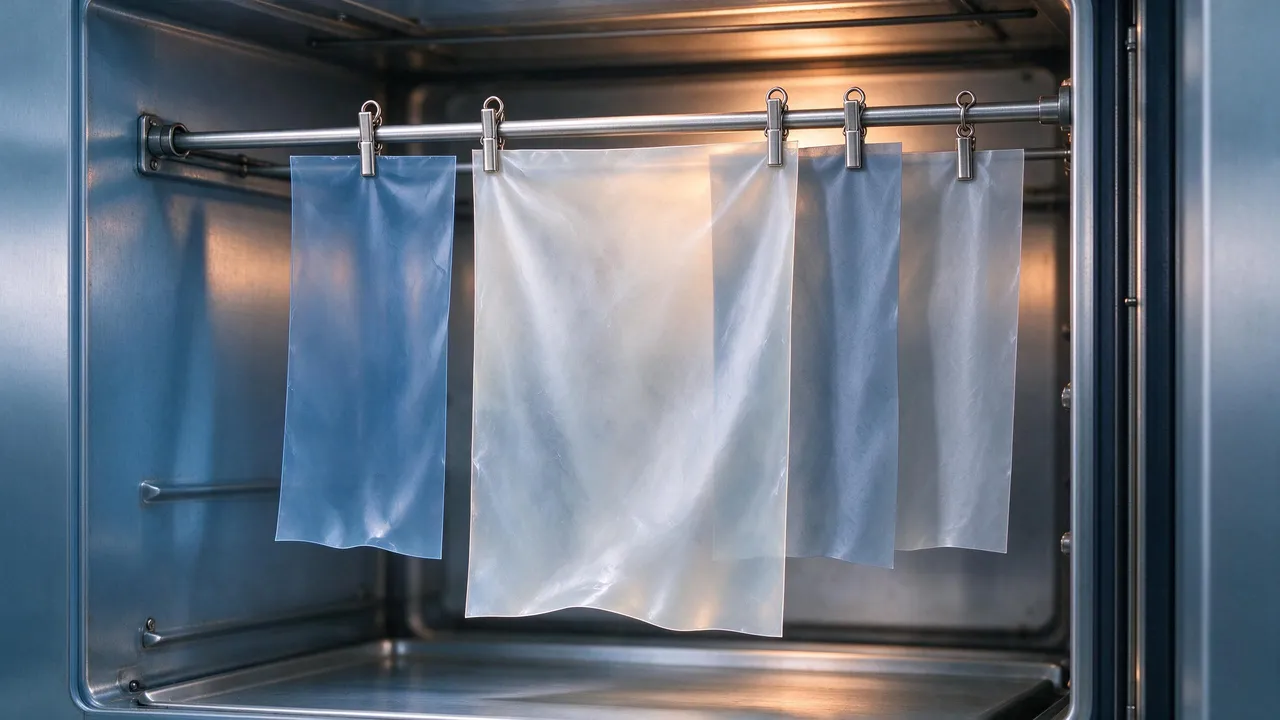
Short answer: Heat and oxygen can alter TPU through radical oxidation, including chain scission and crosslinking. Primary and secondary antioxidants interrupt different reactions; their effectiveness depends on the formulation and exposure. Specify processing history and an agreed heat-aging comparison. Neither an additive name nor a single temperature establishes finished-film service life.
TPU can change under heat and oxygen even before obvious visual damage appears. Loss of elongation, discoloration or cracking can have several causes; oxidation is one possible contributor. Assess the complete film and exposure rather than treating appearance or a short test as proof of long service life.
This guide reviews oxidation, antioxidant roles, processing history and interpretation of heat-aging data. Mechanisms and table conditions are general teaching examples, not CHISI formulations, test reports or warranty limits. Agree temperature, duration, specimen construction and each property’s acceptance criterion for the actual product.
On this page
What thermal oxidation means
Thermal oxidation involves reactions between a polymer and oxygen under heat. Radical initiation and subsequent reactions depend on the polymer structure, impurities and conditions. The simplified chain-reaction model below explains possible pathways; it does not identify the dominant mechanism in every TPU or coating.
Changes in polymer structure can affect mechanical and optical behavior. A complete PPF also contains coating, adhesive and interfaces, so self-healing or impact performance cannot be attributed to the TPU chain alone. Temperature, time and oxygen exposure should be recorded. The yellowing guide provides related background; yellowing alone does not establish thermal oxidation as its cause.
Radical reactions: scission and crosslinking
A simplified model separates initiation, propagation and termination. Initiation creates radicals; oxygen reactions and hydroperoxide formation or decomposition can propagate oxidation. Radical termination ends particular reaction chains, but does not restore polymer structure already changed. Several pathways may operate together.
Scission shortens polymer chains; crosslinking joins chains. They can coexist and change strength, elongation or stiffness, but a softer or harder specimen alone does not identify either mechanism. Morphology, coating and other degradation processes also matter. Compare measured properties under defined conditions instead of assigning one universal failure pattern.
| Mechanism stage | Possible film response | Control to evaluate |
|---|---|---|
| Initiation | Radicals may form before visible change | Assess processing peaks, residues and stabilizer suitability |
| Propagation | Oxidation reactions can alter molecular structure and properties | Evaluate radical-trapping and peroxide-decomposition functions |
| Termination | A reaction chain ends; prior changes remain | Do not assume cooling reverses chemical damage |
Primary and secondary antioxidants
Primary antioxidants interrupt radical reactions; hindered phenols are one common class, not the only one. Their role is to limit oxidation, not guarantee that no radicals or damage occur. The appropriate system must be evaluated for the actual resin and film construction.
Secondary antioxidants can decompose hydroperoxides into non-radical products. Phosphites are an important class, particularly during processing; other classes also exist. Combination with primary antioxidants may be beneficial, but superiority at an equal total dose is not universal. The UV stabilizer guide covers related light-stabilization functions; their interaction with thermal stabilization also needs evaluation.
Processing window and thermal history
Set processing temperature, residence time, drying and other conditions from the actual resin supplier’s guidance and qualified process. Oxidation is only one possible source of thermal damage. There is no universal safe processing window for all TPU grades, coatings or complete films.
Record peak temperature, residence time and repeated heating where relevant. Thermal history can influence subsequent behavior, but a hotter process does not by itself quantify remaining life or antioxidant content. Use traceable processing information and appropriate tests; do not infer service life from a normal-looking roll.
Comparing stabilization systems
Compare additive classes, balance, compatibility and measured results for the actual resin. A primary-only, secondary-only or combined description is not a performance grade. More additive is not automatically better: migration, appearance and interactions may require assessment. Do not infer CHISI’s recipe from these general categories.
| System example | Main function | Potential contribution | Evaluation limit |
|---|---|---|---|
| Primary example: hindered phenol | Radical trapping | Limits particular propagation reactions | Does not cover every degradation pathway |
| Secondary example: phosphite | Hydroperoxide decomposition | Limits a source of further radicals | Not a substitute for all radical-trapping functions |
| Combined example: phenol + phosphite | Complementary functions | Potential benefit during processing and use; verify | Balance, compatibility and appearance require evaluation |
| System with light stabilization | Multiple degradation pathways considered | Evaluate heat and light exposure together | Interactions and consistency must be qualified |
This table explains functions, not additive doses or a purchasing formula. Ask for appropriate specification and test evidence within the supplier’s disclosure scope. A generic additive claim is insufficient, but it does not entitle buyers to confidential formulation details.
Heat-aging comparisons and acceptance
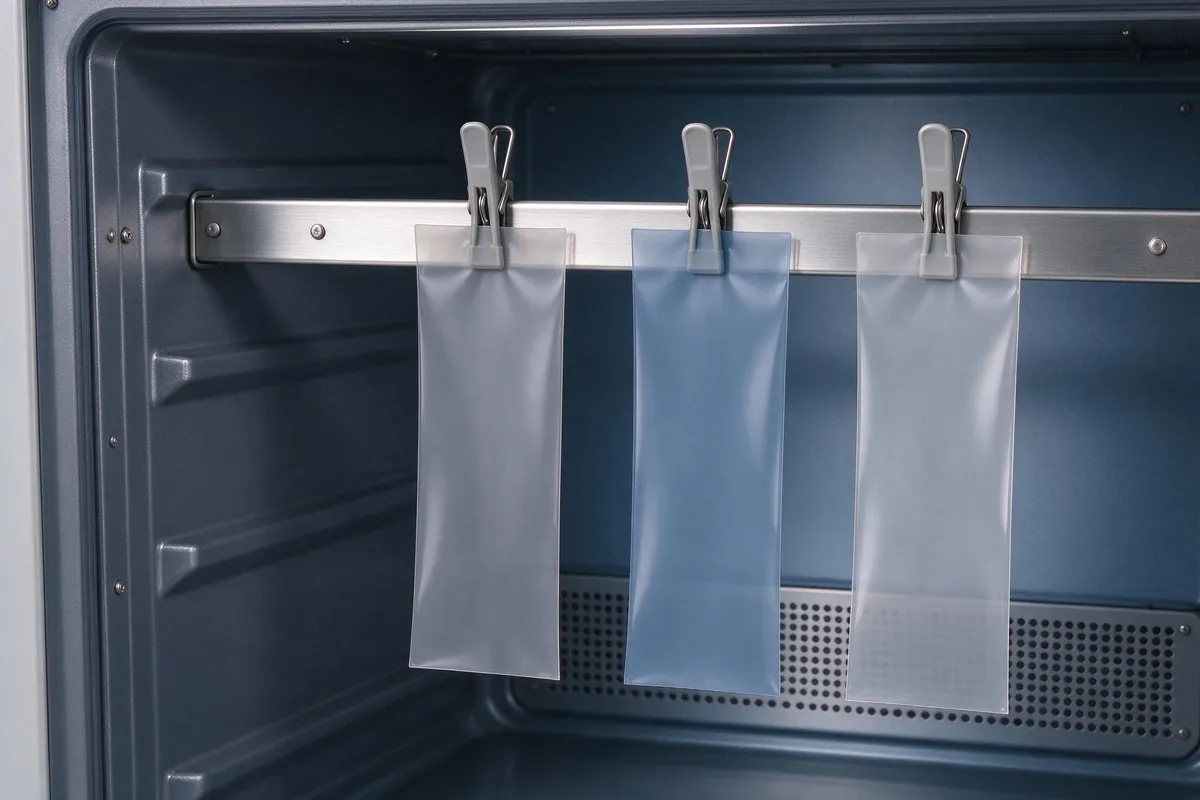
Specify duration, airflow, specimen construction and conditioning. Record tensile strength and elongation separately, with each retained value calculated against its own baseline. These results do not alone identify a mechanism or predict years in service.
| Test step | What to record | Record | Acceptance basis |
|---|---|---|---|
| Oven exposure at 100 °C | Defined air circulation and agreed duration | Strength and elongation retention, separately | Agreed product-specific limit; no new result supplied |
| Oven exposure at 120 °C | Agreed duration; not automatically equivalent to 100 °C | Property retention and defined color measurement | Compare only under the agreed method and criterion |
| Specimen condition | Define thickness, layers, support and stress state | Measure the baseline before exposure | Comparable specimens from the same defined lot |
| Acceptance | Product-specific purchasing specification | Results and uncertainty against each criterion | Agree limits before testing and supply |
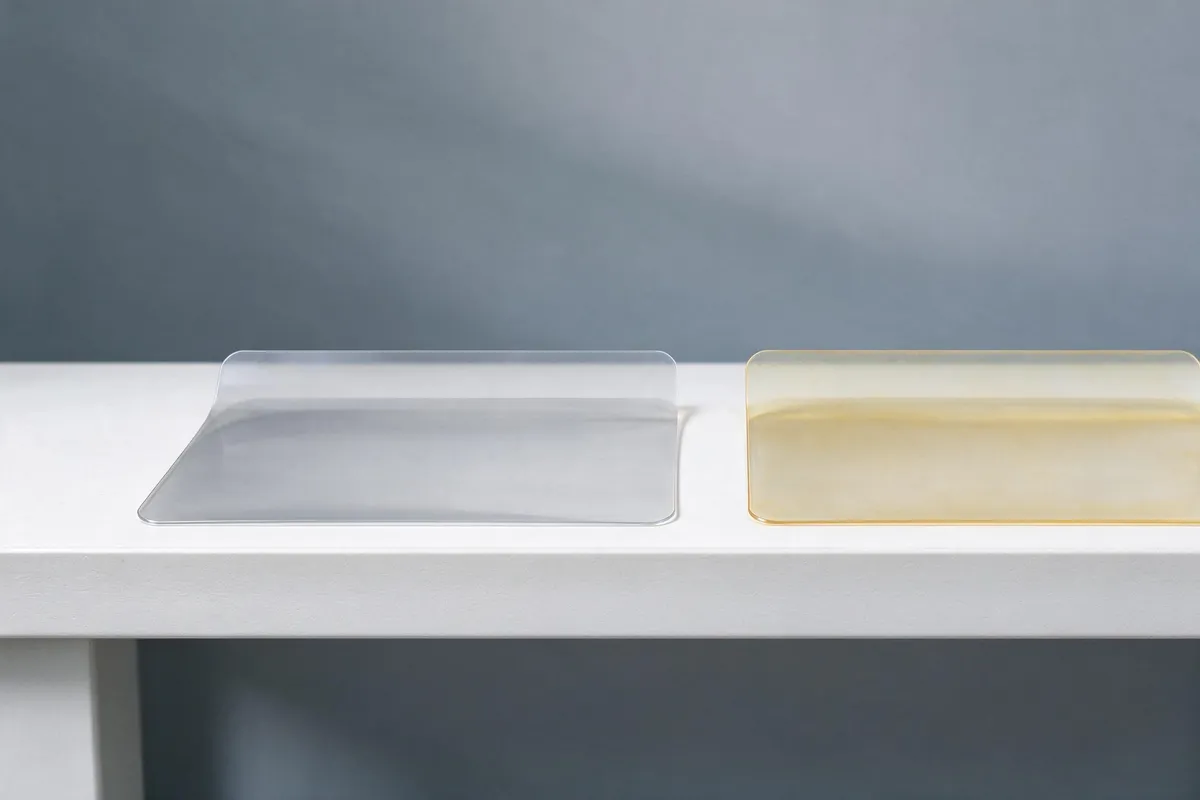
Agree the criterion before testing. Record temperature, duration, specimen state, baseline, sampling and lot history so the comparison can be interpreted. Retention of one property is not a standalone remaining-life estimate or proof that all layers remain suitable. The hardness and modulus guide discusses additional measurements; changes in these properties also require interpretation rather than a single-cause diagnosis.
Frequently asked questions
How do scission and crosslinking differ?
Scission shortens chains; crosslinking joins them. Both can occur and affect mechanical behavior. A change in hardness or elongation alone cannot establish the dominant mechanism; assess the actual material and exposure with suitable evidence.
Why combine primary and secondary antioxidants?
They can provide complementary radical-trapping and hydroperoxide-decomposition functions. Benefits depend on resin, additives and conditions; a combination is not automatically superior for every film or equal total dose. Confirm performance through appropriate testing.
Is more antioxidant always better?
No universal dose applies. Compatibility, processing, appearance and possible migration matter alongside oxidation control. Use a qualified system for the actual formulation rather than maximizing a dose or publishing an inferred CHISI recipe.
Why record thermal history?
Peak temperature, residence time and repeated heating can affect the material’s condition. Record them with the qualified process. They do not alone quantify additive depletion or remaining service life, even when films share a nominal formula.
What does tensile retention mean?
Report tensile-strength retention and elongation retention separately, each relative to its own unaged baseline. State the method, specimens and aging conditions. The result supports a defined comparison, not a direct conversion to years, warranty or the cause of every property change.
Is testing at 120 °C mandatory?
Choose the aging temperature and exposure time for the material and the property being tested. Compare results under the same protocol and use the Type R specification for its own test conditions.
Does cooling reverse oxidation damage?
Cooling or rest should not be assumed to restore chemically altered chains. Physical relaxation or surface recovery is a different issue and does not prove oxidation was reversed. Prevention and verification concern the actual material and exposure.
Can UV stabilization replace thermal stabilization?
The functions overlap and interact, but a UV-stabilizer label does not establish protection against every heat-and-oxygen exposure. Evaluate the combined system under relevant conditions; neither label discloses CHISI’s formulation or guarantees complete-film durability.
Discuss material requirements
Describe the application, climate, expected exposures and purchasing criteria. Discuss available product-specific specifications and testing with the supplier. This guide does not promise a custom stabilization formula, an existing report for every SKU or a guaranteed service-life result.
See the R&D and factory overview for company context, not a test report for the selected film. To discuss qualification evidence or an OEM project, contact our team with the intended market, product and exposure conditions.